
How Much Money Do Restaurants Lose When Tourists Can't Read the Menu?
Find out how language barriers affect restaurant revenue, tourist spending, order size, and customer service quality — and how a multilingual menu can help solve this problem.
Four guests sit down at a table in a restaurant in the center of a European city, ten minutes' walk from the main square. Two of them speak the local language. The other two do not. The menu is printed in only one language and slightly water-stained after a whole summer of terrace service.
What happens next doesn't look like a dramatic scene. Nobody complains. Nobody asks for a different menu. The two guests who can't read it simply point at what their friends ordered, tell the waiter "the same, please" — and skip the appetizer and the glass of wine they might otherwise have chosen. The final bill comes out lower than it could have been. The restaurant will never find out, because nothing about this situation looked like a problem. It looked like an ordinary Tuesday.
This is the quiet form of the language barrier. It doesn't lead to a bad review. It doesn't cause a scene at the till. It simply removes some of the options from the table before the guest even gets the chance to consider them — and it happens on a scale most restaurant owners have never tried to measure.
The cost hidden inside an ordinary shift
Restaurant owners in European cities with heavy tourist traffic intuitively understand that foreign guests are a significant part of their business. It's far harder to see how much potential revenue quietly evaporates at the very moment a guest opens a menu they only partly understand.
The commercial case for tackling this problem starts with a simple, well-documented pattern: tourists don't just eat out more often — when they do, they spend more per visit than local diners. According to research from the National Restaurant Association, foreign guests typically spend 40–60% more per restaurant visit than local diners. Where a local guest's average check runs around €35, a tourist's check at the same restaurant often falls in the €50–65 range. Tourists experience dining out as part of the travel experience, not a routine errand — so they're more likely to order a starter, a dessert, or a glass of wine they might not choose at home.
That's the extra potential of any restaurant in a tourist area. But there's an important catch: that higher-spending behavior depends on the guest actually understanding what's on offer. FlipMenu's research also points to a second, related figure: guests who can read the menu in their own language spend an estimated 8–12% more per visit than those who can't fully understand it. Put these two numbers together, and a telling picture emerges — tourism brings a guest into the restaurant who is statistically inclined to spend generously, and a menu they can't read quietly claws back a meaningful share of that potential spending before it ever happens.
40–60%
How much more foreign tourists spend on a restaurant visit compared with local guests
National Restaurant Association
8–12%
How much more guests who can read the menu in their own language spend on a visit, compared with those who can't
National Restaurant Association
1.5 billion
International tourist arrivals worldwide surpassed 1.5 billion in 2025
UNWTO
The scale of this opportunity — and, at the same time, this potential loss — is not small at all. According to UN World Tourism Organization (UNWTO) data, international tourist arrivals worldwide surpassed 1.5 billion in 2025. In the US alone, FlipMenu's analysis notes, foreign tourist spending topped $185 billion in a single year, with restaurants capturing the second-largest share of that spending, right behind hotels. A comparable pattern holds in major European tourist destinations, where dining out is one of the primary ways to experience a city.
None of this is exotic or new. What's missing from almost every discussion of tourist menus is a simple way to translate the observation "tourists spend more when they understand the menu" into a concrete question: "How much is this actually costing my restaurant right now?" Most advice on this topic stops at the observation itself. Restaurant owners are left with a vague sense that money is slipping away, with no way to size it.
Why a confused guest orders less, not just differently
To understand where the money actually goes, it helps to look at what happens, behaviorally, when someone is handed a menu in a language they don't speak well.
The instinctive reaction is not to ask for help. Most guests, especially in a culture where sending a menu back or peppering the waiter with questions can feel socially awkward, default to what researchers and hospitality writers call the "safe choice." They recognize a familiar word (pizza, pasta, chicken) and order exactly that, even if with full information they'd have chosen something else. They skip the dish with the interesting but incomprehensible description. They don't ask what "catch of the day, prepared with a regional reduction" means, because doing so requires a conversation in a foreign language — in public, at the table, with other people listening.
It's worth separating two behavioral scenarios here: ordering a smaller amount and refusing to order at all. The first is the two guests at the table in the example above, who choose what's familiar and skip the extras. The second is more serious: a potential guest looks at the menu through the restaurant window, can't quickly make sense of it, and moves on. Multilingual menu service doXmenu, drawing on patterns in the tourism industry, puts it directly: language barriers cause guests to order less, and when they genuinely can't understand the menu, they either choose safe options — or leave.
The second effect quietly accumulates with every order that's missing a starter, a side, or a dessert the guest would have chosen with full understanding of the menu. It's not one big loss. It's hundreds of small losses, repeated at every service, throughout the entire tourist season.
Language barriers cause guests to order less. When guests can't understand the menu, they choose safe options — or they leave
There's also a second, quieter category of loss that runs alongside missed upselling: order accuracy. When staff have to explain, gesture, or guess what a guest who doesn't speak the restaurant's language is trying to order, the risk of mistakes rises — the wrong dish, a missed allergy mention, a dietary requirement lost in translation. Restaurant technology reviews focused on multilingual ordering systems regularly cite improved order accuracy as one of the most obvious operational benefits of a clear, translated menu, though the specific percentages circulating in industry marketing materials vary in reliability and aren't always confirmed by independent studies — so they're best treated as a directional benchmark rather than a precise statistic.
What the research actually confirms — and what to treat with caution
Any serious analysis of this topic runs into a familiar problem: much of the statistical data repeated across hospitality-technology blogs traces back to the same small group of sources, or has no clearly identifiable original source at all. Being precise about which figures are reliable and which are marketing shorthand matters a great deal, especially for an operator deciding whether the problem is even worth addressing.
The figures that hold up relatively well under scrutiny are the ones attributed to named external research organizations rather than to claims by vendors themselves: the tourist spending premium (National Restaurant Association) and the increase in spending linked to understanding the menu's language (though the primary study behind the 8–12% figure isn't independently cited in the source material, so this indicator should be treated as a well-grounded industry estimate rather than a peer-reviewed statistic). The claim that international tourist arrivals surpassed 1.5 billion in 2025 broadly aligns with the trend in UN World Tourism Organization reporting in recent years, though the exact annual figures should be checked against the latest UNWTO release before using a specific number in a business plan.
One figure worth treating with particular caution: some restaurant solution providers cite a study linked to the University of Illinois, according to which professional photos of dishes increase orders of those specific dishes by up to 30%. This claim circulates widely in restaurant marketing materials, but the original study isn't always directly cited and is hard to independently verify — so it should be treated as a plausible, widely repeated industry claim rather than a confirmed fact.
This matters for a simple reason: vendors often sell restaurant owners certainty along with their product. The honest picture is more modest and, frankly, more useful — the direction of the effect is well supported by several independent observers, even when the exact percentages aren't always reliable.
A rough model: what the language barrier could be costing your restaurant
None of the figures above, on its own, tells the owner of a specific restaurant exactly how much they're losing. But together they're enough to build a conservative estimate.
Imagine a restaurant serving 150 guests a day, a fifth of whom — 30 guests — are foreign visitors who aren't fluent in the local language. If the average check for a local guest is €35, and tourists really do spend 40% more when the service goes well (the low end of the National Restaurant Association range), a tourist's check with full understanding of the menu would come to around €49. Applying a more conservative estimate of the language-comprehension effect — an 8% penalty for a menu the guest only partly understands — brings that down to around €45.
For 30 guests a day, that difference amounts to roughly €120 in unrealized revenue every working day. Over a six-month tourist season of continuous operation, that adds up to roughly €20,000–€22,000 in revenue that never shows up at the till — not because the restaurant did anything wrong, but because thirty guests a day were quietly ordering less than they would have with a menu they could read comfortably.
This is a simplified, illustrative model, not a guaranteed outcome for any specific business. A restaurant with a larger or smaller share of foreign guests, a different average check, or a different tourist mix will land on a different number. The point of the example is to show the nature of the loss, not to predict an exact amount for any particular venue.
What sets this loss apart from more visible operating costs, like food waste or staff turnover, is that it never shows up anywhere as a separate line item. No supplier invoice points to it. No manager flags it at the weekly meeting. It simply shows up as an average check that's slightly lower than it could be, at every service where a significant share of the room doesn't speak the local language.
The part of this problem almost no one in the industry talks about
Almost every piece of content about multilingual menus treats the problem purely from a commercial angle — as a missed sales opportunity. What's largely overlooked, especially for restaurants operating within the European Union, is that menu comprehension for foreign guests isn't only a sales issue. In one specific respect, it's also a legal one.
Under EU Regulation (EU) No 1169/2011 on the provision of food information to consumers, food businesses across the entire European Union — restaurants included — are required to disclose the presence of fourteen specified allergens in the dishes they serve, whenever those allergens are used as ingredients. The list includes, among others, cereals containing gluten, crustaceans, eggs, fish, peanuts, soybeans, milk, tree nuts, celery, mustard, sesame, sulphur dioxide and sulphites, lupin, and molluscs. Member states have some latitude in exactly how this information must be provided — verbally by staff, in writing on the menu, or through a clearly signposted reference document — but the obligation itself to make this information genuinely accessible to the guest applies across the entire EU.
This is exactly where the tourist-menu problem stops being purely a matter of optimizing the average check. A guest who can't read a description in their own language is, by definition, less able to determine whether a dish is safe for them. Asking a waiter with no shared language to explain the difference between "may contain traces of nuts" and "prepared in a fryer shared with other dishes" is a genuinely difficult task, especially when it has to be done accurately, under time pressure, with a language barrier on both sides. Research on serving tourists repeatedly notes that international travelers are particularly anxious about allergens precisely because it's hard for them to communicate dietary restrictions in a foreign language — and that anxiety is a rational response to a real communication barrier, not an overreaction.
We covered allergens in more depth on the Platoo: Allergen Guide page
It's worth stating clearly here: the specific requirements for how allergen information must be presented vary from one EU country to another, so restaurant owners should confirm the exact local rules with their national food safety authority rather than relying on a general description. The obligation itself, however, is not optional and doesn't disappear just because the guest doesn't speak the local language.
For a restaurant serving a significant number of foreign guests, this completely changes the context of the discussion. A menu available only in the local language isn't just lost revenue — for guests with genuine dietary restrictions, it can mean the difference between a safe, informed choice and a choice made at random, under social pressure. A restaurant doesn't need to translate every regulatory document into 11 languages to honor the spirit of this requirement, but a menu that clearly and accurately communicates allergen information in the languages actually spoken by its core guest base occupies a far stronger position — both commercially and in terms of guest safety.
It's worth stating clearly here: the specific requirements for how allergen information must be presented vary from one EU country to another, so restaurant owners should confirm the exact local rules with their national food safety authority rather than relying on a general description. The obligation itself, however, is not optional and doesn't disappear just because the guest doesn't speak the local language.
Printed multilingual menu vs. digital menu: what it actually costs
Once a restaurant accepts that the menu-comprehension problem is worth solving, the practical question becomes: how exactly? The traditional answer — print the menu in two or three additional languages — carries costs that are easy to underestimate until you add them all up.
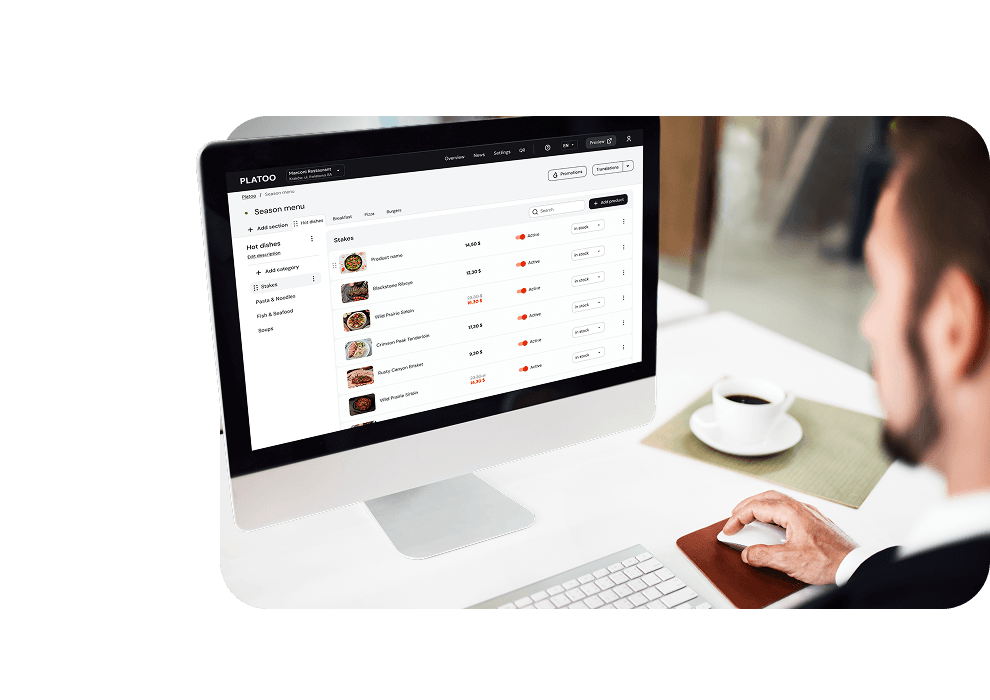
A menu translated into four languages isn't simply four times as much text. Either the physical document becomes four times longer and quickly turns into an unwieldy format for the guest, or you end up with four separate printed booklets, each of which has to be kept in stock, stored, and handed to the right guest. An analysis of exactly this problem points directly to the operational costs: when a restaurant changes a price or adds a new dish, every language version has to be updated — and for a printed menu, that means a full reprint of every affected version, not a quick edit.
Digital or QR menu
- ✓All language versions exist as a single entry per dish; changing a price or description updates all language versions simultaneously
- ✓Guests choose their own language, so staff don't have to guess or ask
- ✓No reprinting costs for seasonal changes, price adjustments, or removing temporarily unavailable dishes
- ✓Initial setup and translation still require attention — automatic translation without native-speaker review carries its own risks
Printed multilingual menu
- ✕Each language exists as a separate physical document, or the menu becomes considerably longer
- ✕Any price change or new dish requires reprinting every affected language version
- ✕Staff have to correctly identify which language the guest needs and find the right copy
- ✕Design and printing costs recur with every menu change
Translation quality deserves separate attention, regardless of format. The guidance on this point is worth taking seriously: automatic translation shouldn't be used for dish names without a native-speaker review, because a literal translation often produces something linguistically correct but meaningless — or unintentionally unappetizing — in the target language. The same guidance recommends keeping genuinely traditional or regional dish names in their original language, rather than translating them by force (for example, "Tavë kosi" retains far more meaning if the name is left as is, with a short description added, than if it's turned into an awkward, unnatural literal English equivalent).
This is a real, ongoing quality-control task, not a one-off job at launch. The menu changes — seasonal dishes come and go, prices are adjusted, descriptions are refined — and every one of those changes needs to propagate correctly across all supported languages, ideally without needing to involve a human translator every single time, even for changing a single ingredient.
Typical scenario
Picture a family-run café in a coastal town that gets a significant seasonal influx of visitors from three or four different countries every summer. For most of the year, the menu exists only in the local language — for a mostly local winter clientele, there's no obvious reason to permanently maintain a translated version.
At the height of the season, staff notice a familiar pattern: visiting guests point at dishes, repeatedly ask "what's this?" during the busiest service, and — particularly telling — rarely order from the specials board, which changes daily and is never translated. Based on his own observation, the café owner has noticed that dessert orders drop noticeably at tables where English isn't the shared language, even though the desserts are clearly visible on the chalkboard.
None of this turns into a formal complaint. It shows up as summers where the till records a healthy number of covers, but an average check management can't fully explain, especially given how stable the food cost percentage looks. This is a hypothetical, composite scenario, built from patterns described across several sources in the restaurant industry, not a specific real business — but most owners running venues in similar seasonal tourist locations will recognize a familiar situation in it.
In situations like this, the problem is rarely visible enough to trigger a deliberate fix. It's precisely the accumulation of small, invisible decisions — skipping the dessert, ordering "the same as him," not asking about the special — that adds up to the quieter version of the losses described earlier in this article.
What can a restaurant practically do about this problem?
None of this requires completely restructuring how the restaurant operates. The measures that help close the language-comprehension gap can usually be introduced gradually, sequenced by effort and expected impact.
- Identify the actual language mix of your guests, rather than guessing. Check the languages of reviews on Google Business Profile, ask front-of-house staff to note which languages come up most often over two weeks, or consult local tourism board data, if available. Getting the languages wrong means the translation effort ends up going toward the wrong priorities.
- Prioritize two or three languages first, rather than trying to cover everything at once. Most restaurants can cover a substantial share of their international guests with a small, well-chosen set of languages rather than an exhaustive list.
- Have translations checked by a native speaker, especially dish names and descriptions, before publishing them anywhere guests will see them. Machine translation is a reasonable starting point for structure and speed, but it doesn't replace a human check on tone and accuracy.
- Make allergen information genuinely accessible in your guests' languages, not just formally present somewhere in the local language. This helps meet the requirements of EU food information law while also removing a real source of guest anxiety.
- Keep the menu easy to update. Whatever format you choose, being able to quickly fix a price, remove a sold-out dish, or add a seasonal item without a full reprint or a slow manual process across every language version matters more, over a whole season, than the effort of the initial setup.
- Revisit your language mix periodically. Tourist flows shift from year to year and season to season; a menu translated once and never revisited will, over time, stop matching who's actually walking through the door.
Related reading
Frequently Asked Questions
Research from the National Restaurant Association, cited by FlipMenu's analysts, puts the difference at roughly 40–60% per visit. This is because tourists experience dining out as part of the trip, not as a routine activity.
The direction of the effect is confirmed by several independent sources in the hospitality industry: guests who fully understand the menu tend to order with more confidence and more completely. The specific percentages, often cited in the 8–12% range, are based on industry analysis rather than a single peer-reviewed study, so it's better to treat them as a well-grounded estimate rather than an exact figure.
Yes. EU Regulation No 1169/2011 requires food businesses, restaurants included, to disclose the presence of fourteen specified allergens in dishes served to guests. The specific way the information is disclosed (menu text, verbal notice, or a reference document) can vary by EU country, so restaurants should confirm local rules with their national food safety authority.
Printed multilingual menus generate recurring costs with every price or dish change, since every affected language version typically needs to be reprinted. Digital menus eliminate exactly those costs, though they too require careful translation, ideally checked by a person, to avoid imprecise or unnatural wording.
There's no universal answer — it entirely depends on the actual mix of visitors to a specific location. Checking the languages of reviews on platforms like Google Business Profile and asking staff which languages they hear most often from guests is a more reliable starting point than assumptions based on general tourism statistics.
It's a reasonable starting point in terms of speed and structure, but guidance on translating hospitality materials consistently recommends having a native speaker check the result before publishing, especially for dish names, since literal machine translation often produces something formally correct but meaningless or unappetizing to a native speaker.
Sources: EU Regulation No 1169/2011 · EU Regulation (EU) No 1169/2011 on the Provision of Food Information to Consumers · UN World Tourism Organization (UNWTO)