
QR Code Menu vs. Paper Menu: What EU Restaurant Owners Should Actually Choose
Independent surveys, industry data, and GDPR guidance compared: when a QR menu for restaurants beats paper, when paper still wins, and how to build a hybrid menu strategy that fits your restaurant.
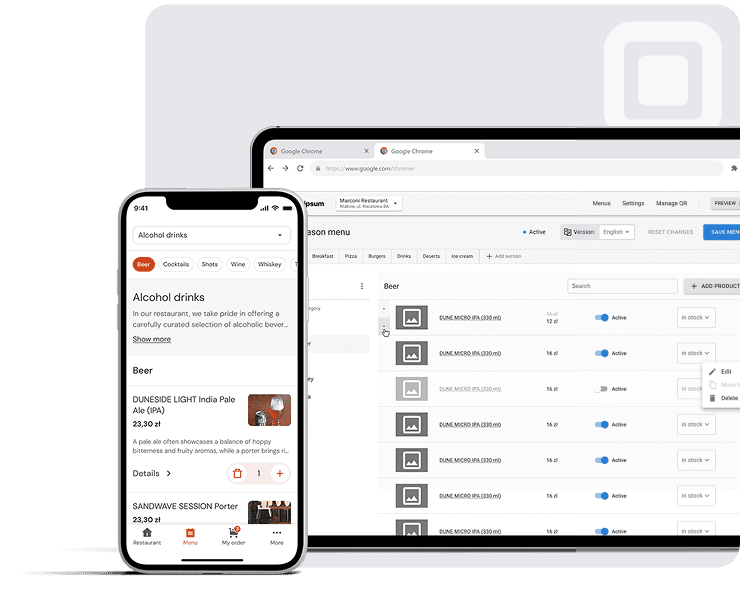
If you run a restaurant in the EU, you've probably had this argument with yourself more than once: keep the printed menus your regulars know and love, switch fully to a QR code, or try to run both without confusing anyone.
The honest answer is that the data doesn't point in one direction — it points in several, depending on your restaurant type, your guests' age profile, and what you're actually trying to fix: cost, speed, hygiene, or experience.
This guide pulls together independent research, industry surveys, and academic studies on QR code menus versus paper menus — not vendor marketing — and turns it into a decision framework you can actually use.
By the end, you'll know which format fits your restaurant, what the real trade-offs are, and how to avoid the QR code mistakes that quietly cost operators revenue.
The Real Numbers: Do Customers Actually Prefer QR or Paper?
Ask ten different surveys whether customers prefer QR code menus or paper menus, and you'll get ten different answers — sometimes wildly contradictory ones.
That's not because the research is bad; it's because most surveys are measuring different things at different moments in the dining journey.
88%
of consumers prefer paper menus over QR menus for sit-down dining
Technomic / Restaurant Business Online, 2022
67%
of consumers agree QR code menus are more sanitary than paper
Technomic, 2022
10%
average decrease in check size reported after switching to QR-only menus
PYMNTS, 2024
The headline numbers, side by side
| Survey | Year | Finding |
|---|---|---|
| Technomic (Restaurant Business Online) | 2022 | 88% of consumers prefer paper menus over QR code menus |
| PYMNTS Digital Divide Study | 2022 | 51% of grab-and-go customers say QR menus improve satisfaction — but only 26% of dine-in customers agree |
| PYMNTS Intelligence / Paytronix | 2024 | Only 31% of nearly 2,400 US consumers felt positively about viewing a menu via QR code |
| PYMNTS Digital Divide Study | 2022 | Millennials are the only generation where a majority (51%) view QR menus positively; only 16% of baby boomers and seniors agree |
The pattern that emerges once you line these up is this: context matters more than the technology itself. A QR code menu performs reasonably well when a customer is grabbing food quickly and just wants to order fast. It performs badly when a customer has sat down for a meal they want to linger over, browse, and enjoy at their own pace.
Why the Technomic and PYMNTS figures look so different
The Technomic survey (n=1,000, May 2022) asked specifically about sit-down dining preference — the exact scenario where paper wins.
The PYMNTS grab-and-go figure captures a completely different use case: fast, transactional food purchases where nobody expects a leisurely menu-reading experience.
When you see a headline stat like "88% hate QR menus" or "78% love QR menus" floating around without context, the first question to ask is: which dining occasion was actually measured?
The generational split, unpacked
Generational data is one of the most consistent findings across every independent source we reviewed:
- Baby boomers and seniors: overwhelmingly prefer paper (up to 95% in some samples). Frustration centers on unreliable phone cameras, unfamiliarity with scanning, and simply not wanting to use a smartphone at the table.
- Gen Z: counter-intuitively, also leans toward paper (86% in the Technomic survey) — despite being the most digitally native generation. Their complaints echo the same themes as older diners: it feels less like dining out and more like doing a chore.
- Millennials: the most QR-friendly generation, but even here, preference tops out around 51–82% depending on the study and dining context — never a landslide.
- Gen X and "bridge millennials": sit in the middle, generally leaning paper but less strongly than boomers.
The takeaway for EU operators: if your customer base skews toward business lunches, families, or an older demographic, a QR-only menu is a real risk to guest satisfaction. If you run a fast-casual concept with a younger, urban clientele, QR-first is far more defensible.
Where QR Menus Win: Speed, Cost, and Hygiene
None of this means QR code menus are a bad idea — they solve real operational problems, and the data backs that up clearly in specific areas.
Menu updates without reprinting costs
This is the most durable, least controversial advantage of QR menus. Every time you change a price, remove a sold-out dish, or add a seasonal item, a printed menu means a reprint. A QR-linked digital menu means logging in and editing a page.
For restaurants that update menus seasonally, weekly, or even daily — specials boards, wine lists, allergen updates — this isn't a marginal convenience. It removes an entire recurring cost and operational bottleneck.
Table turnover and service speed
Quick-service and QSR brands have the clearest data here. Restaurant Brands International — the parent company of Burger King and Tim Hortons — reported that a unified QR scan-and-pay feature drove a 7% year-over-year improvement in guest satisfaction and a 10% boost in drive-thru speed of service, according to comments from CEO Josh Kobza on the company's Q3 2023 earnings call.
That's a meaningful throughput gain in a high-volume environment where seconds per transaction matter.
The hygiene perception advantage
QR menus emerged largely as a pandemic-era solution to a genuine concern: shared, frequently-touched paper menus as a contamination vector. That framing has stuck.
In the Technomic survey, 67% of respondents agreed that QR code menus are more sanitary than paper menus — even among people who otherwise preferred paper on every other dimension. This is one of the few areas of near-universal agreement across the generational divide.
Loyalty and data integration
QR codes aren't just menus — they're also becoming the connective tissue between in-store visits and digital loyalty profiles. Sweetgreen added in-store loyalty check-in QR codes in 2023 specifically to unify its online and offline customer data.
PYMNTS Intelligence data from the same period found that 51% of consumers already use a restaurant loyalty program, with quick-service loyalty adoption growing 15% year-over-year — a trend QR-based check-in is well positioned to capture.
Where this leaves you: if your core priorities are operational efficiency, frequent menu changes, high table/order volume, or building a connected loyalty program, QR menus deliver concrete, measurable benefits.
Where Paper Menus Win: Experience, Accessibility, and Revenue Per Table
This is the section most vendor content skips over, because it's inconvenient for anyone selling QR software. But the independent data on this is consistent and worth taking seriously.
Readability is a genuine, unsolved problem
In the same Technomic survey where 67% of people conceded QR menus were more sanitary, 55% said QR code menus are hard to read and browse, and 66% specifically disliked having to pull out their phone the moment they sat down.
Technomic's own director of consumer insights, Robert Byrne, made an important observation: digital scrolling breaks conventional menu design logic. Printed menus are engineered — through layout, boxing, and eye-flow — to draw attention to high-margin items and specials. A vertically scrolling phone screen makes that kind of intentional visual hierarchy far harder to execute.
Reddit sentiment collected by Food Network in 2024 echoed this in blunt consumer language: complaints centered on menus that were just PDFs "slapped" onto a phone screen, requiring constant scrolling, and simply being unreadable in low restaurant lighting.
The revenue-per-table problem
This is the statistic that should get every restaurant owner's attention: one restaurant group reported a 10% decrease in average check size after switching to QR code menus, according to reporting cited by PYMNTS in 2024.
The underlying mechanism is straightforward — diners scrolling through a phone screen are demonstrably less likely to browse the entire menu than diners flipping through a physical one. If your dessert page, your premium wine list, or your specials board is buried three scrolls down, it may as well not exist.
This directly undercuts one of the most commonly cited QR "benefits" (upselling via digital menu design) — the effect can just as easily run in reverse if the menu isn't deliberately engineered for scroll behavior.
Accessibility and the guests QR menus leave behind
"People are frustrated, especially people 40 years and older. Sometimes their phones don't work. They don't know how to access the QR code. So, before they even get to order a beverage, they're already upset, and that hampers the entire customer experience." — Michele Baker Benesch, president of Menu Men
This isn't a fringe complaint. It touches:
- Guests without smartphones, or with older devices that struggle to scan
- Guests in areas with weak cell reception (a QR code is useless without a working data connection)
- Guests who simply don't want to use a personal device at a restaurant table
- Guests with visual impairments who may find small-screen text harder to navigate than a well-designed physical menu
The dining-experience factor
"[The QR-code menu is] the antithesis of romance." — a restaurant owner, quoted by The New York Times via Business Insider, 2023
The New York Times reporting captured a sentiment that's hard to quantify but easy to recognize: the QR-code menu pulls guests' attention onto their phones and disrupts conversation.
Kristen Hawley, founder of the restaurant technology newsletter Expedite, was even blunter, telling the Times that QR-code menus "are almost universally disliked."
Where this leaves you: if your restaurant sells an experience — fine dining, date-night ambiance, a leisurely brunch, a place people go specifically to switch off from their phones — a fully QR-only approach works directly against your value proposition.
Privacy, Data Tracking, and QR Security — What EU Owners Need to Know
This is the area where EU operators face considerations that most of the (largely US-sourced) research and reporting on this topic simply doesn't address. It's worth treating carefully rather than glossing over.
What a QR code menu actually collects
Depending on how the digital menu platform is built, a QR scan can capture: the device type, approximate location, time of scan, session duration, and — if the platform is connected to ordering or loyalty — order history and payment data.
This is precisely the kind of first-party data that makes QR menus attractive for personalization and marketing. It's also personal data under EU law the moment it can be linked, even indirectly, to an identifiable individual.
GDPR considerations (general guidance, not legal advice)
If you operate in the EU, any QR-linked platform that collects guest data is subject to the GDPR's core obligations: a lawful basis for processing, transparent guest-facing information about what's collected and why, data minimization, and — where the platform shares data with third parties — appropriate data processing agreements.
None of the consumer surveys or academic papers reviewed for this piece address GDPR specifically, which tells you something important: this compliance work isn't optional, and it isn't being done for you by default just because a QR menu platform is popular in the US.
Practical steps before you deploy a QR menu in the EU:
- Confirm your vendor's data hosting location and whether data leaves the EU/EEA
- Publish a clear, accessible privacy notice at the point of the QR code itself, not buried three clicks deep
- Avoid collecting more than you need — a menu doesn't require a customer's full contact details to function
- Get a written data processing agreement with any third-party menu or loyalty platform
This section is general guidance, not legal advice. Consult a data protection professional before finalizing your QR menu vendor selection.
QR phishing ("quishing") — a real, rising risk
In December 2023, the US Federal Trade Commission issued a formal consumer warning about "quishing" — scammers placing a fraudulent QR code sticker directly over a legitimate restaurant's code, redirecting unsuspecting diners to a spoofed payment or phishing site.
While this warning came from a US regulator, the attack method is not US-specific, and EU restaurants using table-mounted QR codes are equally exposed.
Simple mitigations:
- Use tamper-evident QR code stands or table inserts rather than loose stickers
- Periodically physically inspect codes for signs of an overlay
- Ensure your digital menu redirects only to HTTPS URLs, and train staff to recognize a "wrong-looking" menu page if a guest flags one
- Consider rotating QR codes periodically rather than using a single static code indefinitely
Sustainability: The Environmental Case for Going Digital
Independent academic research gives QR menus their strongest, least-contested advantage in this category. A 2023 case study published in the Journal of Information Technology Teaching Cases (Ozturkcan & Kitapci) laid out the sustainability argument in detail, tying QR code menus directly to three United Nations Sustainable Development Goals:
- SDG 12 (Responsible Consumption and Production): QR menus reduce paper and food waste — the latter by allowing restaurants to promote near-expiry items or dynamically remove sold-out dishes rather than over-preparing to match a fixed printed offering.
- SDG 13 (Climate Action): eliminating repeated print runs reduces the energy, ink, and paper-production footprint tied to frequent menu updates.
- SDG 17 (Partnerships for the Goals): digital menus make it easier for restaurants to transparently communicate sourcing practices — local, organic, or lower-carbon-footprint ingredients — directly to guests at the point of ordering.
For EU operators, this matters beyond pure environmental conscience. With EU sustainability-reporting expectations tightening across the hospitality sector, a documented reduction in single-use paper consumption is the kind of concrete, quantifiable claim that holds up under scrutiny — far more so than vague "eco-friendly" marketing language.
A caveat worth stating plainly: none of the sources reviewed for this article provide a verified, restaurant-scale figure for exactly how much paper or carbon a typical EU restaurant would save by switching. If sustainability reporting is a genuine priority for your business, it's worth commissioning your own measurement rather than relying on generic industry claims.
The Hybrid Model: How to Combine Both (By Restaurant Type)
Almost every serious source on this topic — academic, journalistic, and industry-survey alike — eventually arrives at the same conclusion: the answer usually isn't "QR or paper," it's "QR and paper, weighted differently by context." What's missing from most of that coverage is a practical way to decide how to weight it. Here's a framework built around four common restaurant profiles.
| Restaurant type | Primary format | QR use case |
|---|---|---|
| Fine dining | Paper, with intentional, high-quality design as part of the atmosphere | Narrow and supplementary — wine list detail, allergen information, or a sommelier pairing guide |
| Casual & family dining | QR-first for efficiency, paper available on request | Full ordering and menu browsing, with a "request a printed menu" prompt at seating |
| Fast-casual & QSR | QR/kiosk-first, minimal or no paper | The core ordering mechanism, ideally integrated with loyalty and payment |
| Bars & nightlife | QR for speed, paper (or a printed cocktail card) for storytelling | Fast reordering during peak hours when staff bandwidth is the bottleneck |
A practical rule of thumb across all four: whatever primary format you choose, always make the alternative available on request, and train staff to offer it proactively to guests who look like they're struggling with a QR code rather than waiting to be asked.
The accessibility complaint that shows up repeatedly in the research isn't really about QR codes being bad technology — it's about restaurants treating the alternative as unavailable rather than optional.
How Platoo Solves the Common Complaints About a QR Menu for Restaurants
If you've read this far, the pattern in the complaints is clear: it's rarely the concept of a QR menu for restaurants that frustrates guests — it's poor execution. Platoo was built directly around the failure points identified in the independent research above.
- ✓Mobile-optimized menu design that respects visual hierarchy: rather than a static PDF dropped onto a phone screen — the single most common complaint in the Food Network and Technomic data — Platoo menus are built to preserve the kind of deliberate eye-flow and item highlighting that print designers have always used, adapted properly for scrolling rather than fighting against it.
- ✓Fast loading even on weak internet: Platoo menus are built to load quickly on slow restaurant Wi-Fi or patchy mobile data, using lightweight pages and optimized images so guests aren't left staring at a spinner instead of ordering.
- ✓EU-based data handling: given the GDPR considerations outlined above, Platoo's infrastructure is built with EU data residency and processing transparency in mind from the outset, rather than as an afterthought.
- ✓Update speed without design compromise: menu changes — pricing, sold-out items, seasonal specials — go live instantly, without sacrificing the layout quality that keeps upsell items visible instead of buried three scrolls down.
The goal isn't to argue that QR menus are universally right or that paper is obsolete — the data in this article doesn't support either claim. It's to make sure that if you do choose a digital menu, it's one engineered to avoid the exact problems that show up, again and again, in independent research on this topic.
Related reading
Frequently Asked Questions
It depends heavily on context. Independent surveys show a strong overall preference for paper menus in sit-down dining (as high as 88% in Technomic's 2022 survey), but QR menus perform better in grab-and-go and fast-casual settings, where over half of customers report a positive impact on satisfaction. Preference also varies sharply by generation, with millennials the most QR-friendly and baby boomers the least.
Perception-wise, yes — 67% of consumers in the Technomic survey agreed QR menus are more sanitary than shared paper menus, a view that holds fairly consistently across age groups even among people who otherwise prefer paper.
Directionally, yes — eliminating recurring reprint costs is one of the most consistently cited benefits across the research. However, no independent, EU-specific figure exists for exactly how much a typical restaurant saves; treat generic savings claims with caution and, where possible, calculate your own based on your actual printing frequency and volume.
A QR menu itself is just a delivery mechanism — compliance depends entirely on how the underlying platform collects, stores, and processes guest data. EU operators should confirm data hosting location, ensure clear guest-facing privacy information, and secure a data processing agreement with their vendor. This is general guidance, not legal advice.
For most restaurants outside pure fast-casual or QSR formats, yes. A hybrid approach — QR as the primary or supplementary format depending on your restaurant type, with paper genuinely and proactively available — captures the operational benefits of digital menus while avoiding the accessibility and experience complaints that show up consistently in independent research.
Not automatically. "Quishing" — fraudulent QR stickers placed over legitimate codes — is a documented risk flagged by regulators including the US FTC. Using tamper-evident code holders, checking codes periodically, and ensuring your platform only redirects to secure (HTTPS) URLs are practical mitigations any restaurant can implement.
Sources: Restaurant Business Online (Technomic) — Customers really don't like QR code menus · PYMNTS — QR Code Ordering Reaches New Venues Despite Consumer Ambivalence · PYMNTS — Millennials Like QR Code Menus. Others? Not So Much · PYMNTS — QSRs Tap QR Codes to Expand Loyalty Recognition in Stores · PYMNTS — Turning Point Restaurants on Tapping QR Codes, Digital Loyalty Programs · PYMNTS — Restaurants Reintroduce Paper Menus Amid Customer Complaints About QR Codes · SAGE Journals (Ozturkcan & Kitapci) — A Sustainable Solution for the Hospitality Industry: The QR Code Menus · Business Insider (via Yahoo Finance, reporting The New York Times) — People Hate QR-Code Menus · Food Network — Are Paper Menus Making a Comeback? · Axios — QR Code Menus Top List of COVID Changes People Hate · ScienceDirect — Deciphering the Dilemma: The Impact of QR Code Menus on Customer Loyalty · ResearchGate — The Impact of QR Codes on Customer Satisfaction For Repurchase Intention · ResearchGate — QR Code Menus: Exploring the Role of QR Codes in Enhancing Operational Efficiency · Restaurant Dive — Digital Restaurant Orders Growing at a Double-Digit Clip · Blue Book Services (reporting Deloitte's "Restaurant of the Future" survey) · US Federal Trade Commission — Consumer Alert on "Quishing"