
Menu Price Display Rules in the EU: VAT and Service Charges
EU menu price display rules require VAT-inclusive prices and any restaurant service charge or cover charge to be visible before guests order, on paper and QR menus.
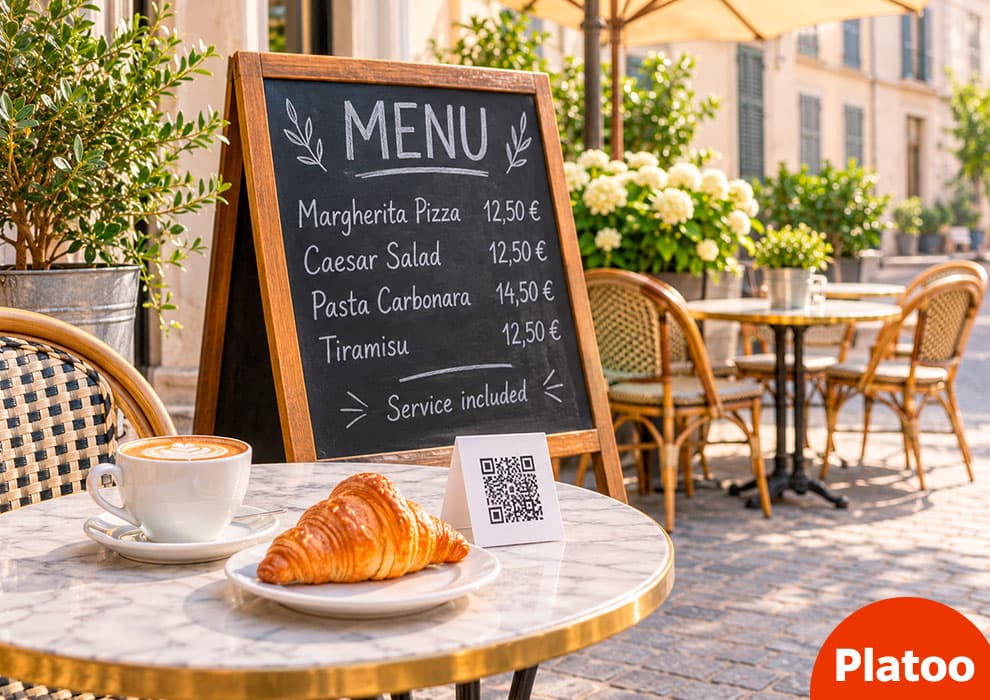
EU menu price display rules require VAT-inclusive prices and visible service or cover charges before guests order, on paper, terrace boards and QR menus alike.
Typical scenario: a couple finishes dinner on a terrace. The bill arrives, and near the bottom sits a cover charge neither of them saw on the menu. They query it, the waiter points to a line of small print by the door, and the evening ends in an argument about who is right.
Usually the guest has the stronger case. Menu price display rules across the EU rest on one simple idea: the price a guest sees before ordering should be the price they pay. Dish prices must already include VAT. Any service or cover charge has to be disclosed where the guest can see it, not revealed on the bill.
The details vary by country, from where the notice goes to whether a QR code alone is enough. This guide walks through the EU framework, national rules, terrace and tourist pricing, digital menus, discounts and the UK approach, then ends with a checklist to run before service.
This is general information, not legal advice. Check current national rules or ask a local adviser before changing your menus.
Key takeaways
- Every listed menu price must be the VAT-inclusive final price, not a net figure with tax added at the till.
- A cover or service charge that guests discover only on the bill can amount to a misleading omission, even when every dish price is correct.
- If a charge is not on the menu or on a sign the guest can see before ordering, it is hard to defend and the guest can contest it.
- France’s consumer authority, the DGCCRF, does not allow mandatory price displays to be accessible only through a QR code.
- A “reduced” price must be genuine, because a fake discount can still count as misleading under the UCPD.
Which EU Laws Actually Govern Restaurant Menu Prices?
Three EU directives set the principles for restaurant prices, but the detailed rules inspectors check come from national law in each Member State. The EU defines what a price must contain; your country decides how a menu shows it.
Why the Price Indication Directive Often Stops at the Restaurant Door
The Price Indication Directive 98/6/EC looks like the obvious starting point. Article 2(a) defines the selling price as the final price for a unit of product, including VAT and all other taxes. Article 4(1) requires it to be unambiguous, easily identifiable and clearly legible.
The catch is Article 3(2). It lets Member States exempt products supplied in the course of a service, and a restaurant meal is exactly that kind of product.
Many countries fill the gap with their own national price display rules for restaurants. So when a venue has to post a menu at the entrance, that duty usually stems from Member State law, not from the directive.
What Does the UCPD Require When a Menu Invites Guests to Buy?
It requires the price inclusive of taxes, plus any additional charges or at least the fact that they may be payable. Under the Unfair Commercial Practices Directive 2005/29/EC, Article 7(4)(c), a restaurant menu listing dishes with prices is an invitation to purchase, so this information is material.
That classification is the mechanism: once a menu is an invitation to purchase, a missing charge becomes information the guest needed before ordering.
A cover or service charge that guests discover only on the bill can amount to a misleading omission, even when every dish price is correct. The wording of such charges is covered further on.
Services Directive Article 22: Price Information Before the Service
The Services Directive 2006/123/EC adds a timing rule. Article 22(1)(i) obliges providers to make the price available when they set it in advance. Article 22(4) adds that this must happen in a clear and unambiguous manner and in good time before the service is provided.
For a restaurant, “in good time” means before the guest orders, not when the bill arrives.
| Aspect | Price Indication Directive | UCPD Art. 7(4)(c) | Services Directive Art. 22 |
|---|---|---|---|
| Core demand | Final price incl. VAT, clearly legible | All-in price, extra charges disclosed | Pre-set price available in good time |
| Reaches restaurants? | Only where national law extends it | Yes, via the menu | Yes, as service providers |
Enforcement sits with national consumer authorities such as France’s DGCCRF, Ireland’s CCPC, Poland’s UOKiK and Inspekcja Handlowa, and Portugal’s ASAE. Before reprinting, compare your layout with what a complete restaurant menu template must include, and check local specifics with your chamber of commerce.
Menu Price Display Rules for VAT: One Final Price Per Item
Restaurant owners often ask: should menu prices include VAT? Across the EU, the answer is yes: the figure next to a dish is meant to be the figure the guest pays. Directive 98/6/EC, Article 2(a), defines the selling price as the final price for a unit of the product, including VAT and all other taxes. The UCPD’s final-price requirement points the same way for any priced menu.
Can a Restaurant Show Menu Prices Without VAT?
No, not on a menu aimed at consumers. Under EU menu price display rules, every listed price must be the VAT-inclusive final price, not a net figure with tax added at the till.
Germany goes a step further: PAngV § 13 also folds service into the listed price. Service and cover charges elsewhere are covered in the next section.
What Happens to Menu Prices When the VAT Rate Changes?
The listed prices have to be reviewed, because the final price is what counts.
Germany is the current test case. Under § 12(2) No. 15 of the VAT Act (UStG), as amended by the Steueränderungsgesetz, restaurant food is taxed at 7% from 1 January 2026. The German Chamber of Commerce (DIHK) advises restaurants to check and carefully adjust POS systems and price lists after the change.
Whether to pass the cut on to guests is a commercial decision, not a legal one. For the arithmetic, see our guide to restaurant menu pricing methods and margin formulas.
Food and Drinks at Different VAT Rates, One Figure for the Guest
The VAT Directive 2006/112/EC, Annex III point 12a, lets Member States apply a reduced rate to restaurant and catering services and to exclude beverages from it. Germany uses both options: food at 7%, drinks at the standard 19%.
Illustrative example
A Berlin bistro lists a schnitzel at €18.90 and a glass of wine at €6.50. Both are gross prices. The schnitzel carries 7% VAT and the wine 19%, but the menu shows only the two totals. The split belongs on the bill (the note, tique or apodeixi), where each item appears at its VAT-inclusive price and the tax is shown separately.
Receipt requirements differ by country, so confirm the format with your tax adviser.
Restaurant Service Charges, Cover Charges and Tips: What Must Be Disclosed?
Any compulsory extra, whether a service charge, a cover charge or a bread charge, must be visible to the guest before they order. If a charge is not on the menu or on a sign the guest can see before ordering, it is hard to defend and the guest can contest it. Tips are the exception, because they are voluntary by definition.
Guests often ask: do you have to pay a service charge in a restaurant if nobody mentioned it? A quick test for the venue: could the guest have known about the charge before choosing a dish? If only the bill told them, the disclosure came too late.
Is a Service Charge Legal on an EU Menu?
Yes, as long as it is disclosed up front. The Unfair Commercial Practices Directive 2005/29/EC makes extra charges part of its final-price requirement. Hiding a service charge until the bill arrives is therefore the textbook omission the directive targets.
Some countries go further and fold service into the dish price. Germany’s Price Indication Ordinance (PAngV), § 13(5) builds the Bedienungsgeld into the menu price. In France, the DGCCRF expects prices to include taxes and service, with the mention “Prix service compris”.
In Poland, UOKiK has reportedly said a service charge is lawful only if the guest learns about it before ordering. Inspekcja Handlowa carries out the on-site checks.
Coperto, Couvert, Cubierto: Cover and Bread Charges by Country
| Country / region | Local name | What the authority says |
|---|---|---|
| Italy | coperto | Payable only if the amount is written clearly on the menu; otherwise the guest may contest it |
| Lazio (Italy) | coperto | Regional law 21/2006 is reported to ban it, though the practice reportedly persists in Rome |
| France | couvert | DGCCRF allows a charge for a guest sharing another’s dish only if its price is stated on the menu |
| Madrid (Spain) | cubierto | Cover, bread or aperitivos may be charged only if listed on the menu or a visible sign |
| Portugal | couvert | According to consumer group DECO Proteste, items the guest did not order or eat may not be charged |
For Italy, the regional picture is not uniform. The national public-safety law on displaying prices (art. 180 TULPS) sits alongside local rules. Where your region is unclear, confirm the local rules before printing a cover charge.
Tip vs Service Charge: What Is the Difference for the Guest?
A service charge is set by the venue; a tip is set by the guest. That difference decides where each one belongs. If the charge is compulsory, it belongs in the displayed price or in a clear notice before ordering. A gratuity stays at the guest’s discretion.
Ireland’s CCPC draws the line plainly: mandatory service charges must be very clearly communicated in advance, and optional ones must not be added to bills automatically.
Illustrative example
A bill shows a €40 meal plus €4 “optional service” already totalled. Under the CCPC’s guidance, that amount should be left for the guest to add, not removed on request.
Country-by-Country Menu Price Display Rules in the EU
EU directives set the minimum. What a guest sees at the door, though, comes from national price display rules for restaurants in each Member State’s own law. That is why a menu that passes in Lyon can be incomplete in Cologne or Dublin.
France: Outside Display, Five Wines and ‘Prix Service Compris’
The core text is the arrêté du 27 mars 1987. According to the DGCCRF, menus or the carte du jour must be displayed outside for the whole service, and at least from 11:30 for lunch and 18:00 for dinner. Alongside them go the prices of five wines, or five commonly served drinks if no wine is served.
Prix affichés must include taxes and service, with the mention “Prix service compris”. Set menus must also say whether a drink is included: boisson comprise or non comprise.
What Does Germany Require at the Restaurant Entrance?
A price list displayed beside the entrance, showing the prices of the main food and drinks on offer. That is the rule in the Price Indication Ordinance (PAngV), § 13 on Gaststätten, paragraph 2.
Inside, the list must be posted legibly, laid on tables, or handed to each guest before ordering and on request at billing. Paragraph 5 adds that menu prices must include the service charge (Bedienungsgeld) and all other surcharges.
Italy, Spain, Portugal and Greece: Cover Charges and Tourist Areas
In Italy, art. 180 TULPS (R.D. 635/1940) requires public establishments to display their price tariff where the public can clearly see it. Consumer group Altroconsumo says an undisclosed coperto can be contested.
Spain regulates largely by region. The Comunidad de Madrid consumer authority, for example, requires global prices including taxes and service, an itemised ticket, free non-bottled water and complaint forms (hojas de reclamaciones) on request.
For Portugal and Greece, the points below come from consumer bodies, not the legal texts, so confirm them locally. DECO Proteste reports that Portuguese venues may not charge couvert or anything the guest did not order or consume. The European Consumer Centre Greece describes a VAT-inclusive price list (timokatalogos) in Greek outside the main entrance, with a notice that guests need not pay without a receipt.
Poland and Ireland: Quantities, Notices and Entrance Lists
Poland’s ustawa o informowaniu o cenach towarów i usług of 9 May 2014 makes quantity part of price information. In a 2022 check by the Łódź Trade Inspection, 42 of 351 menu items (12%) were non-compliant, mainly for missing dish or drink quantity (gramatura or volume).
Ireland’s Retail Prices (Food in Catering Establishments) Display Order 1984, as summarised by the CCPC, requires a price notice immediately outside or inside the entrance. It must state any minimum charge, the service charge and whether it is included, and any cover charge. Pub drink prices fall under the Retail Price (Beverages in Licensed Premises) Display Order 1999.
| Country | At the entrance | Key detail |
|---|---|---|
| France | Menus plus five wines or drinks | “Prix service compris”; drink included or not |
| Germany | Main food and drink prices | Service and surcharges in the price |
| Italy | Tariff clearly visible | Coperto only if on the menu |
| Spain (Madrid) | Varies by region | Itemised ticket, free tap water |
| Greece (per ECC) | Greek price list outside | Receipt notice |
| Poland | Check locally | Quantity of each dish and drink |
| Ireland | Notice outside or inside | Minimum, service and cover charges |
The common thread is that the full price, service and any cover charge included, must be visible before the guest orders; countries differ mainly in where it is shown and what detail it carries. Menu price display rules also shift through regional decrees and amendments, so check with your consumer authority before reprinting.
Terrace Surcharges, Tourist Pricing and Foreign Currency
Tourist areas raise three recurring questions. Can the terrace cost more? Can visitors pay more than locals? And how should a second currency appear? EU law sets the frame, and national price display rules for restaurants fill in the detail.
Can You Charge More on the Terrace Than at the Bar?
Yes, in most Member States, as long as the guest can see the difference before sitting down. The consumer authority of the Comunidad de Madrid, for example, requires price lists to state whether prices differ for table, bar or terrace consumption. That is where the familiar suplemento de terraza comes from.
Each figure must still be the VAT-inclusive final price. The terrace rate therefore appears as its own full price or as a clearly stated supplement, not as a surprise on the bill.
Madrid’s other requirements, from all-in prices to the itemised ticket, are listed in the country section; other regions set their own rules.
Illustrative example
A seaside café lists a beer at €3.00 at the bar and €3.50 on the terrace, in two columns with the volume beside it. A guest who moves outside knows the price in advance, and the bill matches the menu.
Is Charging Tourists More Legal in the EU?
Generally, no. Article 20(2) of the Services Directive 2006/123/EC prohibits general access conditions that discriminate by nationality or place of residence, unless directly justified by objective criteria.
A separate “tourist menu” that charges foreigners more for the same dishes is likely to fall foul of that rule. Differences based on where in the venue a guest sits, the time of day or the portion size are another matter, provided they apply to everyone.
Article 22 of the same directive requires providers to make price information available to customers. Quantities make that information comparable: volume for drinks and weight (gramatura) for dishes, where national law asks for it.
Showing Prices in a Second Currency Without Misleading Guests
A second currency is a courtesy, not a replacement. Keep the euro price as the binding figure and label the other currency clearly. If you cannot guarantee the rate at payment, mark it as an approximate conversion.
The converted figure should never look lower than what the guest will actually be charged.
Language matters too; see what restaurants lose when tourists cannot read the menu.
Do QR and Digital Menus Follow the Same Price Rules?
Yes. A digital menu is still a price display, so it carries the same duties as paper: a VAT-inclusive final price for each item and any service charge disclosed before the guest commits.
Under the Services Directive 2006/123/EC, Article 22(4), price information must be given in a clear and unambiguous manner and in good time before the service is provided. That test does not depend on the medium.
Regulators read it the same way. The UK’s Competition and Markets Authority, in its price transparency guidance CMA209, treats a restaurant menu as an invitation to purchase and says this includes a digital menu accessed by scanning a QR code.
Can a QR Code Replace the Menu Displayed Outside?
Not everywhere, and in France, no. France’s consumer authority, the DGCCRF, does not allow mandatory price displays to be accessible only through a QR code. The price list displayed outside or at the entrance has to stay readable without a phone. Entrance-display rules elsewhere differ in detail, so before removing a printed board, confirm the rules where you trade.
One Price Across Paper, QR, the Entrance Board and Delivery
The bigger everyday risk is inconsistency, especially when you update prices for a new season.
Illustrative example
The entrance board lists a pasta at €14, while the QR menu shows €15. The guest faces two invitations to purchase that disagree, and neither is clear and unambiguous. A delivery listing that drifts from the in-house price raises the same problem.
- Keep one master list with every selling price, all taxes included.
- Change the master first, then the QR menu, printed menu, entrance board and delivery listing in the same session.
- Check that service or cover charge wording is identical in every version.
- Before opening, scan the QR code and compare it with the board.
It is worth seeing how a digital menu updates prices everywhere at once: in Platoo, for example, changes to prices and dishes go live straight away, and the printed QR code stays the same. Paper menus and boards still have to be updated by hand.
To see how prices and dishes look to guests after the scan, open an example menu — no sign-up needed.
Do Discounts and Happy Hours Have Their Own Price Rules?
Yes, though fewer than retailers face. A happy-hour price is still a price: the UCPD’s final-price requirement applies to a half-price cocktail as much as to the full list.
Does the 30-Day Prior Price Rule Apply to Restaurants?
Generally not. Article 6a of the Price Indication Directive 98/6/EC was added by the Omnibus Directive (EU) 2019/2161 and applied from 28 May 2022. It makes sellers show the prior price with any announced reduction: the lowest price applied in at least the 30 days before the cut.
The Commission’s 2021 guidance appears to limit the directive to goods rather than services, though that reading is worth confirming locally. Germany is explicit: the Price Indication Ordinance (PAngV), § 13(1), switches off the prior-price rule in § 11 for restaurants. There is more on restaurant promotions and the EU 30-day prior price rule in a separate guide.
Even where the 30-day rule does not apply, a “reduced” price must be genuine, because a fake discount can still count as misleading under the UCPD.
Timing needs care as well. France’s consumer authority, the DGCCRF, requires a reduced-price menu served only at certain hours to show those exact hours on the menu and on the outside display. If your happy hour runs from 17:00 to 19:00, print that wherever the offer appears; elsewhere, check the national rules.
How Does the UK Handle Service Charges and Drip Pricing?
The UK requires any compulsory service or cover charge to be built into the price a guest sees first, not added later on the bill. Under the Digital Markets, Competition and Consumers Act 2024 (DMCC Act), revealing unavoidable charges after the headline price is drip pricing, and it is treated as an unfair commercial practice.
Must UK Restaurants Include a Mandatory Service Charge in the Price?
Yes. The Competition and Markets Authority’s price transparency guidance (CMA209) names mandatory cover or service charges at a restaurant as a mandatory charge that must be included in the total price. If guests cannot refuse a charge, it belongs in the price next to each dish, not in a line at the bottom of the menu.
CMA209 also treats a restaurant menu as an invitation to purchase, including a digital menu opened by scanning a QR code. The rule therefore applies equally to paper, chalkboards and screens.
The result resembles the continental all-in price (Bedienungsgeld, prix service compris, servizio). The UK simply reaches it through consumer protection law instead.
Discretionary Service Charges and the Tips Act 2023
A genuinely optional service charge raises a second question: who gets the money. The statutory Code of Practice on distributing tips fairly was issued under the Employment (Allocation of Tips) Act 2023. It took effect on 1 October 2024 and covers the fair allocation of tips, gratuities and service charges to workers.
How an optional charge may appear on the menu is a separate part of UK restaurant service charge law; check CMA209 or take advice first.
| Aspect | Mandatory service or cover charge | Discretionary service charge or tip |
|---|---|---|
| Can the guest refuse it? | No | Yes |
| Where it goes on the menu | Inside the headline price of each item | Depends on presentation; check CMA209 |
| Main UK law | DMCC Act 2024, CMA209 guidance | Employment (Allocation of Tips) Act 2023 and Code of Practice |
A Pre-Service Checklist for Compliant Menu Prices
Most price complaints start with a gap between the door, the menu and the bill. A short check against your country’s menu price display rules before each service closes most of them.
- Match the price list displayed outside or at the entrance to the menu inside.
- Confirm every item shows one final price including VAT, on paper and QR menus alike.
- Name the service charge as guests will see it (Bedienungsgeld, prix service compris, servizio) and say whether it is included.
- Show any cover charge (coperto, couvert, cubierto) per person, not in small print.
- Remove expired happy-hour or terrace prices everywhere.
The price at the door, on the menu and on the bill should be the same figure.
In coordinated cross-border actions, UCPD Article 13, as amended by Directive (EU) 2019/2161, requires that the maximum fine available be at least 4% of annual turnover in the Member States concerned, or at least EUR 2 million where turnover data is unavailable. Single-venue fines are national; check with your local chamber of commerce.
Related reading
Frequently Asked Questions
There is no single EU menu law; national rules fill most of the detail. EU consumer law still sets the baseline: under the UCPD’s final-price requirement, a menu must show all-in prices and flag any extra charges. Countries then add their own requirements, such as outside price lists, service-included wording or cover-charge disclosure.
Yes. Under the UCPD’s final-price requirement, guests should see the final amount on a menu, not a net figure plus VAT. National rules repeat this: Germany’s PAngV requires all-in menu prices, and Madrid’s consumer authority sets similar all-in rules. Reduced VAT rates do not change the display duty.
Not as a separate extra. Where restaurants add one, it must be disclosed before the guest orders, and some countries fold it into the dish price instead: France requires “Prix service compris”, and Germany’s PAngV builds service into prices. In Ireland, the CCPC says mandatory charges must be communicated clearly in advance and optional ones not added automatically.
No. Cover, bread and similar charges generally have to be written on the menu before you order. In Italy, an undisclosed coperto can be contested; Madrid allows cubierto or bread charges only if listed on the menu or a visible sign; Portugal reportedly bans charging for anything the guest did not order.
Yes, both expect guests to see prices before they walk in. In France, the 1987 arrêté obliges restaurants to post their menus outside throughout service, together with five wine prices, or five usual drinks if they serve no wine. In Germany, PAngV § 13 asks for a list of the main dishes and drinks next to the door.
No, not everywhere. In France, the DGCCRF rejects mandatory price information that guests can reach only by scanning a code, and in Germany a list beside the entrance is still required. A QR menu works well for the full list inside, but posted prices should stay wherever national law requires them.