
Christmas Starters: 30+ Festive Starter Ideas for Your Restaurant Menu (with Costing, Prep and Allergen Tips)
Christmas starters for restaurants: 30+ festive starter ideas by category, European traditions, food cost and set-menu pricing, prep-ahead service flow and EU allergen rules.
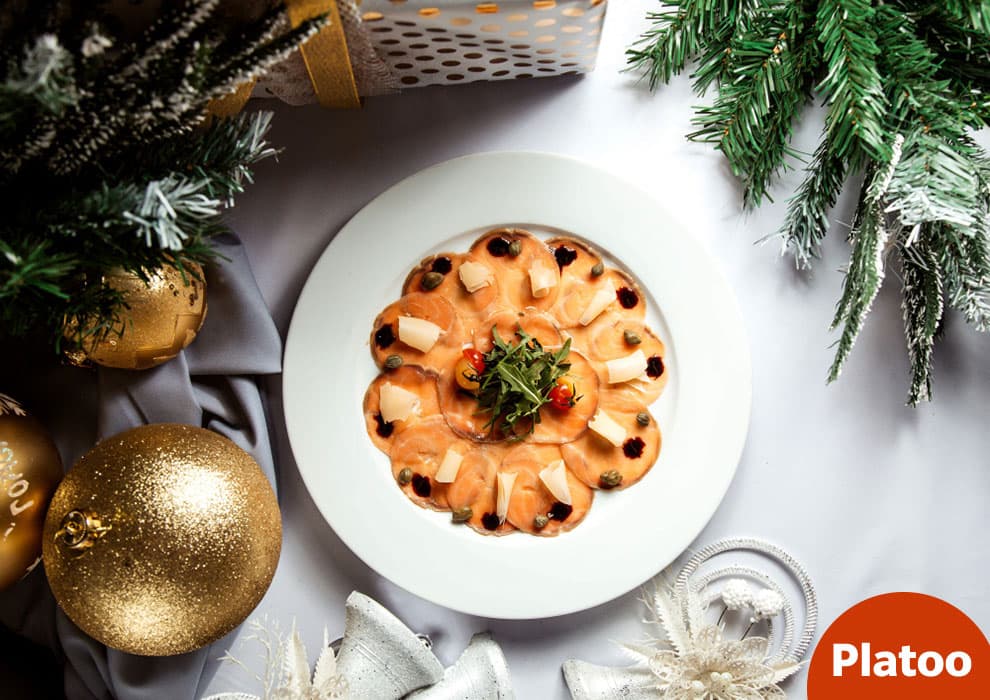
What Makes a Great Christmas Starter on a Restaurant Menu
Ask a chef what sells in December and the answer is rarely the most inventive dish. The classics keep their place on festive menus for a practical reason: soup, pâté and prawn cocktail can all be prepped ahead and keep service moving. That is the test. A starter on a festive prix fixe has to reach every table in a full room at roughly the same moment and leave the kitchen free to focus on the main course.
The strongest Christmas starters share a few traits. Most of the work happens during prep-ahead and mise en place, hours or a day before doors open. Plating takes seconds. The dish holds well, chilled or in a bain-marie, and signals the season through ingredients such as chestnut, cranberry, smoked fish or winter citrus rather than fiddly technique.
How many starters a festive set menu needs
A Christmas set menu works best with a short choice: enough that a mixed party finds something, few enough that each dish can be prepped in volume. Every extra starter adds a prep list, a garnish tray and another chance for a ticket to stall at the pass. For Christmas party group bookings, a short choice also keeps the pre-order list manageable and the prep list exact.
The starter that wins December is the one the pass can send out in a single wave.
Balancing cold, hot, fish, meat and plant-based options
Spread the list across the kitchen, not just across tastes. A cold terrine or prawn cocktail plates from the larder section; a hot soup goes out from one pot. A meat dish adds weight, while a plant-based starter, ideally vegan and gluten-free by design, covers most dietary requests without improvised extra plates. When each station carries part of the load, none becomes the bottleneck.
Christmas Starter Ideas by Category
The ideas below are grouped by category and chosen with the same prep-ahead logic in mind. Each one can taste like an occasion and still leave the pass in seconds.
| # | Category | Starter idea | Prep-ahead note |
|---|---|---|---|
| 1 | Festive soups | Chestnut and wild mushroom velouté | Base freezes well |
| 2 | Festive soups | Roast beetroot soup with horseradish cream | Make two days ahead |
| 3 | Festive soups | Spiced butternut squash soup with toasted seeds | Naturally vegan if made with stock and oil |
| 4 | Festive soups | French onion soup with Gruyère croûte | Grill croûte to order |
| 5 | Festive soups | Jerusalem artichoke soup with hazelnut oil | Purée ahead, finish with oil |
| 6 | Cured and smoked fish | Beetroot-cured gravlax with dill mustard sauce | Cure 48 hours, slice cold |
| 7 | Cured and smoked fish | Smoked salmon with pickled cucumber and rye | Plate in advance, chill |
| 8 | Cured and smoked fish | Hot-smoked trout rillettes with toasted sourdough | Potted the day before |
| 9 | Cured and smoked fish | Smoked mackerel pâté with pickled beetroot | Blend and chill the day before |
| 10 | Shellfish and seafood | Classic prawn cocktail with Marie Rose sauce | Sauce and garnish prepped |
| 11 | Shellfish and seafood | Seared scallops, cauliflower purée, crisp pancetta | Purée ahead, sear to order |
| 12 | Shellfish and seafood | Oysters with shallot mignonette | Shuck to order |
| 13 | Shellfish and seafood | Crab and avocado tian | Ring-mould and chill |
| 14 | Shellfish and seafood | Prawn and avocado verrine | Layer ahead, cover tightly |
| 15 | Pâtés, terrines and rillettes | Chicken liver parfait with cranberry and port jelly | Sets overnight |
| 16 | Pâtés, terrines and rillettes | Ham hock terrine with piccalilli | Slices cleanly cold |
| 17 | Pâtés, terrines and rillettes | Duck rillettes with fig chutney | Keeps under fat for days |
| 18 | Pâtés, terrines and rillettes | Pheasant and pistachio terrine | Press and chill |
| 19 | Pâtés, terrines and rillettes | Venison terrine with red onion marmalade | Press, then slice cold |
| 20 | Warm cheese starters | Baked camembert with cranberry and rosemary | Bake from chilled, portion per two |
| 21 | Warm cheese starters | Goat’s cheese and caramelised onion tart | Blind-bake cases ahead |
| 22 | Warm cheese starters | Baked brie in filo with figs and honey | Wrap ahead, bake to order |
| 23 | Warm cheese starters | Twice-baked cheese soufflé | First bake the day before |
| 24 | Warm cheese starters | Blue cheese and walnut tartlet | Blind-bake cases ahead |
| 25 | Vegetable and vegan | Mushroom and chestnut pâté with oatcakes | Vegan, sets overnight |
| 26 | Vegetable and vegan | Beetroot carpaccio, walnuts, orange | Slice and dress late |
| 27 | Vegetable and vegan | Roast squash, pomegranate and toasted seed salad | Roast ahead, assemble cold |
| 28 | Vegetable and vegan | Roasted carrot and cumin hummus with dukkah | Vegan, make ahead |
| 29 | Canapés and sharing boards | Smoked salmon blinis with crème fraîche | Blinis baked ahead |
| 30 | Canapés and sharing boards | Whipped feta and pomegranate crostini | Toasts keep in airtight tubs |
| 31 | Canapés and sharing boards | Festive sharing board: terrine, cheeses, chutney, grapes | Board built in minutes |
| 32 | Canapés and sharing boards | Parmesan and rosemary gougères | Freeze unbaked, bake to order |
Festive soups
Soup is the workhorse of the festive set menu. Chestnut, beetroot, squash and French onion cover four distinct moods, and one batch can carry a whole sitting. A swirl of horseradish cream or a few roasted chestnut pieces does the festive work without adding plating time.
Cured and smoked fish
Smoked salmon and gravlax read as celebratory across most of Europe. Curing your own gravlax costs time rather than money and gives the menu a house signature.
Shellfish and seafood starters
Prawn cocktail and shellfish starters split into two camps: the retro classic that guests order for nostalgia, and the restaurant-only dish such as seared scallops. Oysters suit venues with confident shucking staff; otherwise a crab tian delivers seafood glamour from a chilled shelf.
Pâtés, terrines and rillettes
Pâté, terrine and rillettes are made for December: produced days ahead, sliced cold, finished with a sharp fruit element. Cranberry, figs and port jelly cut the richness and look seasonal on the plate.
Warm cheese starters
Cheese starters such as baked camembert, goat’s cheese tart and baked brie bring theatre for very little skill. Serve camembert as a sharing starter for two to lift spend per table.
Vegetable and vegan starters
Vegetarian and vegan Christmas starters should feel designed, not subtracted from a meat dish. Chestnut and mushroom dishes carry the same savoury depth as meat, and pomegranate gives colour that photographs well.
Canapés and sharing boards
Christmas appetizers and canapés suit drinks receptions and corporate parties. Blinis, crostini and bruschetta are topped from prepared mise en place in minutes, while sharing boards and cheeseboards let a table graze while mains are fired.
European Christmas Traditions as Starter Inspiration
Many of the best traditional Christmas starters were never designed as starters. They come from Christmas Eve suppers that are fish-heavy, meat-free or both, which makes them light, often make-ahead and friendly to guests avoiding meat. European Christmas food traditions also give each plate a story that tourist guests may recognise from home.
Poland: Wigilia and its meatless starters
According to Culture.pl, the Polish Wigilia supper traditionally has 12 meatless dishes, symbolising wealth, the 12 Apostles and the 12 months, and begins when the first star appears, after opłatek wafers are shared. Starter candidates include barszcz, a fermented beetroot soup with uszka (mushroom dumplings), dried-mushroom soup, herring in oil or cream, and pierogi with sauerkraut and mushrooms.
Italy: La Vigilia and the Feast of the Seven Fishes
National Geographic notes that the Feast of the Seven Fishes is an Italian-American tradition grown from the Southern Italian vigilia, and that “festa dei sette pesci” is not used in Italy, worth knowing before printing it on a menu in Rome. Its dishes suit a sharing board: baccalà, calamari fritti, fried smelt, scungilli seafood salad, clams oreganata and stuffed escarole.
Scandinavia: the julbord herring round
Visit Stockholm says julbord season in the city’s restaurants runs from late November until Christmas, as buffets, tasting menus or à la carte, with pickled herring a fixture. For a plated starter, borrow that round: a herring trio, gravlax with mustard-dill sauce, or a small Janssons frestelse, the creamy potato and anchovy bake. Cured fish is prepared well before service, which suits a busy pass.
France: réveillon foie gras and oysters
FrenchEntrée describes the réveillon de Noël, typically held on the evening of 24 December, as a meal where many families serve snails, smoked salmon, foie gras and seafood, especially oysters (Marennes-Oléron among them), as starters, with blinis appearing earlier with the aperitif. Smoked salmon and gravlax are the easiest bridge between French and Nordic traditions on one menu, while escargots or a French onion soup give a bistro option.
Iberia and the Adriatic: salt cod and seafood
The Centro Interpretativo da História do Bacalhau describes the Portuguese consoada dish as salt cod boiled with kale, served with potatoes and eggs and dressed with hot olive oil, garlic and vinegar (“bacalhau com todos”); a warm salt-cod and kale salad captures it at starter size. The Local Spain lists seafood, langostinos among it, as the focus of Nochebuena, and notes that whole hams are a common Christmas gift. Croatia Week notes that Christmas Eve is traditionally a fasting day with a small evening meal, with bakalar served with salad or cabbage, which adapts well into a whipped bakalar spread on toast.
Greece: fasting-friendly starters
According to Travel.gr, observant Greek Orthodox Christians keep a 40-day Nativity Fast from mid-November to Christmas Eve, avoiding meat, dairy and other animal products, with fish sometimes allowed on Sundays and feast days. A chestnut or roasted squash soup made without cream respects the fast and also covers vegan guests.
| Tradition | Starter idea | Prep note |
|---|---|---|
| Polish Wigilia | Barszcz with uszka | Dumplings freeze well |
| Italian vigilia | Clams oreganata | Bake to order |
| Swedish julbord | Herring trio, gravlax | Cure ahead |
| French réveillon | Oysters, foie gras | Chilled, quick to plate |
| Portuguese consoada | Bacalhau com todos salad | Soak cod in advance |
| Croatian Badnjak | Whipped bakalar on toast | Make-ahead spread |
Costing Christmas Starters: Food Cost and Set-Menu Pricing
December brings the busiest covers of the year, and the starter course is often where margin slips away unnoticed. Extra pomegranate seeds here, another slice of smoked salmon there, and by the second week of service the gross profit per starter that looked healthy on paper has gone.
Working out the cost per portion
Start with the recipe card, not the supplier invoice. List every component of the plated starter, including the protein, dressing, bread, garnish and butter, and cost each at the weight that actually lands on the plate after trimming and cooking loss. Smoked fish, cured meats and shellfish need careful yield calculations. Portion size control matters more in December than at any other time, because seasonal staff and high volumes encourage generous hands. Weigh the protein for the first few services and pin a photo of the reference plate at the pass.
Setting the set-menu price from the target food cost
The standard costing method is simple: divide the portion cost by your target food-cost percentage to get the menu price. Many operators set a cautious target for a Christmas set menu, because festive ingredients cost more and waste runs higher. In menu pricing for set menus the starter rarely has its own price, so apply the formula to the whole festive prix fixe. Add up the most expensive combination of courses and divide by the target. Then compare the starter options with each other. If one costs far more than the rest, guests will choose it and pull the average margin down.
Typical scenario (illustrative figures in EUR)
A three-course festive menu offers beetroot and goat’s cheese at €2.10 per portion and smoked trout at €3.40. The chef cuts the trout to a weighed 60 g, adds a cheap horseradish crème fraîche, and brings the portion to €2.60. The two starters now cost close enough that guest choice barely affects the margin.
Using premium supplements (oysters, foie gras) without raising the base price
Oysters and foie gras draw guests in, but building them into the base price raises it for every table. A supplement keeps the headline price accessible. Cost it with the same formula so it earns its own margin: half a dozen oysters at an illustrative €6 cost should carry a supplement worked out from your target, not a round number picked on instinct. Print it beside the dish and brief front-of-house to offer it, not push it.
Prep-Ahead and Service Flow for Busy Festive Covers
Typical scenario: a December Saturday with two office parties and a full à la carte room is won or lost before the first guest sits down. The starter course takes the hardest hit, because every table orders it at once, so build the whole course around dishes that can be prepared ahead.
What to make days ahead
Soups, pâtés, terrines, rillettes and cured fish are the classic make-ahead Christmas starters: flavours settle, textures firm up, and the stoves are freed for hot mains. How far ahead you go should be set by your own food safety plan, not by habit. Label every batch with production and use-by dates, cool soups rapidly before chilling, and log chilled holding temperatures through the week. Prep-ahead and mise en place for the starter course should also cover the small things: herbs picked, dressings emulsified, croutons and crisps stored airtight, and canapé bases for the bar trayed and wrapped.
Pre-orders for large parties
Christmas party group bookings run far smoother when starter choices arrive before the night. Ask the organiser for a pre-order well in advance, with names against dishes and allergies flagged. Keep the set menu to two or three starters, ideally with at least one cold option that can be portioned early. A seating plan with choices marked lets servers place plates without asking who had what.
Plating cold starters in batches
Service flow for large festive covers and parties depends on removing decisions from the pass. Cold starters can be plated in runs shortly before the party is seated and held covered in the walk-in, so the first course goes out in minutes.
- Count pre-ordered portions per dish and add a small buffer for walk-ins and accidents.
- Lay out plates in rows on cleared benches or trolleys, one dish at a time.
- Plate the base components (terrine slice, cured fish, leaves) on an assembly line, one cook per element.
- Cover, return to chilled holding and record the time plated.
- Add dressings, crisp garnishes and bread only when sending, so nothing goes soggy.
- Send table by table, following the seating plan, with a runner calling allergies at the pass.
Hot soups follow the same principle: hold in a bain-marie at service temperature, pre-warm the bowls and ladle to order.
Covering Vegetarian, Vegan, Gluten-Free and Allergen Needs
In a typical scenario, a Christmas table of ten includes a coeliac cousin, a vegan guest and a grandparent who avoids shellfish. The starter is where those needs meet first, and where a stretched festive kitchen most often slips.
What EU law requires for restaurant menus
If you serve food without prepackaging, one set of information is mandatory under Article 44(1) of Regulation (EU) No 1169/2011 (FIC): the allergens listed in Annex II. The Regulation covers restaurants as “mass caterers”, which Article 2(2)(d) defines as any establishment where food is prepared ready for consumption by the final consumer. These are the 14 EU allergens: cereals containing gluten, crustaceans, eggs, fish, peanuts, soybeans, milk (including lactose), nuts, celery, mustard, sesame seeds, sulphur dioxide and sulphites, lupin and molluscs. Under Article 55, the rules have applied since 13 December 2014.
Article 44(2) lets each Member State decide how that information is given. In Ireland, the Food Safety Authority (FSAI) requires allergens for non-prepacked food in writing, easy to find before sale, either beside each dish or centrally in clearly visible places (S.I. No. 489 of 2014, updated by S.I. No. 656 of 2024). Check your national rules before the festive menu goes out. Article 21(1) requires allergens on prepacked labels to stand out in a distinct typeset. Menus are not bound by it, but the habit makes an allergen display quicker to scan.
Hidden allergens in festive starters (sulphites, mustard, celery, molluscs)
FSAI guidance says allergens must be declared for minor components such as sauces, condiments and beverages, not only the main dish. Festive starters are full of these components.
| Festive starter | Where the allergen hides |
|---|---|
| Chicken liver pâté with port jelly | Sulphites in port and chutney |
| Smoked salmon with dill sauce | Mustard in dressing, milk in crème fraîche |
| Winter vegetable consommé | Celery in the stock base |
| Scallops with Asian glaze | Molluscs, soy in oyster sauce |
Keep an allergen matrix for every starter and update it whenever a supplier, stock or garnish changes.
Starters that cover several diets at once
The most efficient vegetarian and vegan Christmas starters double as gluten-free options. Roasted squash and chestnut soup on a celery-free stock, or beetroot carpaccio with citrus and seeds, serves three diets from one mise en place, and polenta crisps can replace crostini. A clearly labelled plant-based starter also serves guests who observe a pre-Christmas fast, such as the Greek Nativity Fast. A digital menu such as Platoo can show ingredients and allergens next to each dish, keeping the kitchen’s matrix and the guest’s menu in step.
Naming and Describing Festive Starters on the Menu
A guest reading a December menu gives each line only a few seconds, and the starter section is where they decide whether the set menu feels special or routine. Dish naming and menu descriptions do most of that work before a plate leaves the kitchen.
Plain vs descriptive dish names
The most reliable pattern for Christmas starters is a short, clear name followed by one line that covers the main ingredient, the cooking method and the seasonal touch. “Beetroot salad” tells the guest almost nothing; “Roasted beetroot, whipped goat’s cheese, pomegranate and toasted walnuts” tells them what arrives, how it tastes and what might trigger an allergy. Festive garnishes such as cranberry, pomegranate and figs are worth naming outright, because they signal the season better than words like “festive” or “magical”, which guests have learned to skim past.
Keep descriptions to one line where possible. Long paragraphs slow down ordering and push the price out of view. If a dish depends on striking presentation, dish photos on the menu usually do that job better than extra adjectives.
| Before | After |
|---|---|
| Christmas salad | Roasted beetroot, goat’s cheese, pomegranate, walnuts |
| Festive soup | Chestnut velouté, crispy sage, brown butter |
| Chef’s pâté | Chicken liver parfait, fig chutney, toasted brioche |
| Seasonal fish starter | Beetroot-cured salmon, horseradish crème fraîche, rye crisp |
Keeping local names with a short explanation
In tourist locations, local dish names are an asset: they promise something visitors cannot get at home. The mistake is printing them without context. Keep the original name, whether that is vitello tonnato, gravlax, Räucherlachs or pastéis de bacalhau, and add a plain-language line beneath it listing the key ingredients and main allergens. The dish keeps its character, regulars still recognise it, and visitors order with confidence instead of asking staff to translate every line during a full service.
Presenting Your Festive Menu to International and Tourist Guests
The fourth quarter brings foreign visitors in growing numbers. According to Eurostat, nights spent in EU tourist accommodation rose 5.1% in the fourth quarter of 2024 compared with the same quarter a year earlier, and over the full year the growth came from abroad: international guests added 67.2 million nights (+4.9%), while domestic nights slipped 0.1%. For a restaurant near a Christmas market or a hotel F&B team planning festive dining, some of your guests will be reading your starters in a second language.
5.1%
Rise in EU accommodation nights, Q4 2024 vs Q4 2023
Eurostat
+67.2 million
Extra nights by international guests in EU accommodation in 2024
Eurostat
76%
Online shoppers who prefer product information in their native language
CSA Research, 2020
Why language matters on a festive menu
The clearest evidence comes from retail rather than restaurants, but the instinct carries over. A 2020 CSA Research survey of 8,709 consumers in 29 countries found that 76% prefer to buy products with information in their native language, and 40% will never buy from websites in other languages. In an illustrative case, a visitor facing an untranslated “rillettes de canard” feels the same hesitation and orders the one dish they recognise.
Translation works best when it covers the whole dish card, not just the title. A digital/QR menu makes this far easier than printing several language versions; on Platoo’s Business plan, for example, dish names and descriptions are translated automatically into the languages the venue enables, and every translation can be edited by hand.
Photos and allergen icons for guests who can’t read the local language
Dish photos on the menu help international and tourist guests judge the size and look of an unfamiliar starter in seconds. Allergen information matters even more: a consistent set of allergen icons per dish (celery, mustard, nuts, crustaceans) lets a visitor check a terrine or a mousse without decoding the ingredient list. Train staff to confirm verbally, since icons cannot cover cross-contact risks.
To see how dish photos and allergen icons look on a guest’s phone, open an example menu — no sign-up needed.
Launching Your Christmas Set Menu on a Digital QR Menu Without Reprinting
Festive menus have a short shelf life. Reprinting cards for a few weeks of trade is an expense most operators would rather skip. A digital QR menu turns the seasonal switch-over into an admin task.
Prepare the festive menu as a draft
Build the Christmas set menu while the regular menu is still live. On Platoo’s Business plan, for example, a menu can be held as a draft and switched live when you are ready. It only displays the menu; orders and payments stay with your existing setup.
- Duplicate the current menu and rework it into the festive prix fixe.
- Add photos, allergens and translations; have front-of-house check each dish.
- Brief staff, then switch the draft live manually on launch day.
If typing up the festive menu is the part you would rather skip, free of charge.
Switch on, then switch back after the holidays
Printed QR codes stay unchanged, since they keep pointing to the venue’s menu. When the season ends, someone switches the regular menu back on by hand, so put that date in the rota.
Related reading
Frequently Asked Questions
Strong Christmas starters balance one rich plate, one light fish dish and one vegetarian option. Smoked salmon, terrines, chestnut soup and beetroot salads all work, provided each plates quickly, holds well and carries a clear festive cue in its name or garnish.
It depends on the country. British-style menus tend to lean on soup, pâté and prawn cocktail; French réveillon tables often feature foie gras, oysters or escargots; Scandinavian tables favour cured and pickled fish. Tourist venues can pair one regional classic with familiar options for mixed tables.
Three is a sensible working number: one meat, one fish or seafood, and one vegetarian or vegan option. More choices slow the pass and raise waste; fewer leave dietary gaps. Festive à la carte menus can stretch to four or five.
Soups, pâtés, terrines and cured fish are built for prep-ahead and mise en place, within the limits of your own food safety plan. Label batches with production and use-by dates, and add dressings and crisp garnishes only at service.
Roasted beetroot with walnuts, mushroom and chestnut pâté, spiced squash soup or a lentil terrine all hold well and can be made ahead. Check stocks, glazes and wine reductions for hidden animal products.
Yes. Under Article 44(1)(a) of Regulation (EU) No 1169/2011, restaurants serving non-prepacked food must provide information on the 14 EU allergens in Annex II, from gluten-containing cereals to sulphites, lupin and molluscs. Check your national rules for how the information must be shown.
Sources: Culture.pl (Adam Mickiewicz Institute) — The 12 Dishes of Polish Christmas · National Geographic — What is the Feast of the Seven Fishes?, 2023 · Visit Stockholm — Christmas dinner in Stockholm 2026 · FrenchEntrée — Merry Christmas: Celebrating the Réveillon de Noël in France · Centro Interpretativo da História do Bacalhau — Christmas Eve Cod · The Local Spain — Ten traditional delights that make a real Spanish Christmas feast · Croatia Week — Croatian Christmas Traditions · Travel.gr — Greek Christmas Traditions: Where Chapel Light Meets Kitchen Heat · Regulation (EU) No 1169/2011 on the provision of food information to consumers (EUR-Lex) · Regulation (EU) No 1169/2011, Annex II as adopted (legislation.gov.uk) · Food Safety Authority of Ireland — Allergen Information for Non-prepacked Food · Eurostat — EU tourism tops 3 billion nights in 2024 after strong Q4, 4 March 2025 · CSA Research — Survey of 8,709 Consumers in 29 Countries Finds that 76% Prefer Purchasing Products with Information in their Own Language, 2020