
Christmas Market Stalls for Restaurants: How to Get One and Run It Profitably
How to get a Christmas market stall for your restaurant and run it profitably: choosing the right market, real application deadlines from Nuremberg, Dresden, Strasbourg, Cologne and Vienna, what organisers look for, a short stall menu, pricing and margin maths, staff, hygiene and allergen rules.
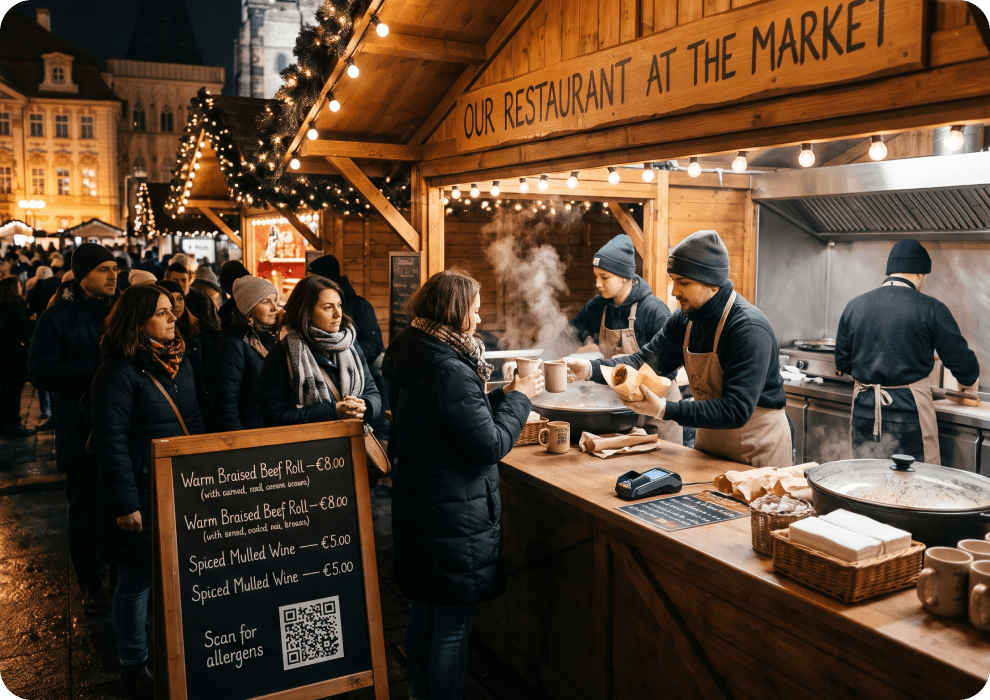
It is a cold December evening. You walk through a busy Christmas market after closing your restaurant. The air smells of mulled wine and grilled sausages, and every stall has a queue. You think: “We could do this. Our food is better than half of what’s here.”
You probably could. But there is a catch. The big markets choose their traders almost a year ahead.
This guide covers both sides of the job. First, how to find the right market and get a stall, with real deadlines from European cities. Then, how to plan the menu, prices, staff and hygiene so the stall makes money.
Part 1: How to get a Christmas market stall
Choose the right market
Not every Christmas market is the same business. Nuremberg says its Christkindlesmarkt attracts roughly two million visitors per market. That footfall comes with strict selection and strong competition from long-time traders.
A neighbourhood market, a hotel courtyard or a shopping-centre market is a different deal. Fewer people walk past. But costs are usually lower, and there may be no one else selling food like yours.
Weigh three things: footfall, cost and competition. Then check the fit. A market that wants regional, traditional food suits a Bavarian inn better than a sushi bar.
It is late October 2026 as we write this. Applications for the big markets this season are already closed. Smaller local markets often recruit later, sometimes only weeks before opening. So we’d look at two tracks: a small market this year, and a big-market application for 2027.
When and how to apply
The big markets work on a fixed yearly calendar. Nuremberg’s deadline for the 2026 market was 28 February 2026, and decisions are expected in May or June. The city publishes the next year’s call during the running market, in mid to late December.
Dresden’s Striezelmarkt published its 2026 call on 9 April, with a deadline of 7 May. Strasbourg takes applications online only, and incomplete ones are not considered.
Some cities do not pick stallholders at all. For the Friesenplatz market, Cologne selected one organiser for 2025 to 2029. You apply to that organiser, not to the city.
Dates change every year, so always check the current call.
| Market | When applications are taken | What stands out |
|---|---|---|
| Nuremberg Christkindlesmarkt | 2026 deadline was 28 February 2026; the next call is published in mid to late December | €30 non-refundable fee per application; disposable tableware banned; about 10% of stalls aimed at newcomers |
| Dresden Striezelmarkt | 2026 call published 9 April 2026, deadline 7 May 2026 | Drink sellers must use official cups, central cup washing and the shared deposit system |
| Strasbourg Christmas market | Online only; check the city’s professional page for dates | Around 300 chalets; exhibitors judged on experience, quality, eco-responsibility, inclusion and creativity |
| Cologne, Friesenplatz | City chose one organiser for 2025–2029 (deadline 16 June 2025) | Traders apply to the organiser; reusable tableware only; food and drink stalls limited to 25% of the market area |
| Vienna, Rathausplatz | For 2024, the window was 1 March to 15 April, online only, according to local press reports | Judged by an expert commission; local press reports about 100 stalls and criteria such as price-performance and organic, regional or fair-trade goods |
| Brussels Winter Wonders | Not published in the sources used here; ask the organiser | The organiser’s website lists 238 chalets for 2026; an Artisan Quality Label is shown at 33 chalets |
The Christmas market stall application process looks similar almost everywhere. These five steps cover it.
- Find the call. Check the city’s market office page or the organiser’s website. Note the opening date and the deadline in your calendar.
- Read the criteria. Look at what the market wants: regional food, a traditional look, no disposables, electric cooking. Mark anything your stall cannot meet.
- Prepare your menu, stall design and photos. Dresden, for example, asks for clear images (six pages at most) and design drafts from new applicants.
- Write a short sustainability plan. Explain your cups, tableware, waste and energy. Many markets score this directly.
- Submit on time and follow up. Send the complete application before the deadline, keep the confirmation, and ask the office when decisions will come.
What organisers look for
Organisers want a market that feels like a Christmas market. Nuremberg admits goods that match the market’s tradition and Christmas character, and free samples are excluded. Its criteria assess stall design and decoration, quality and enough stock, and the reliability of the applicant and staff.
Stall design matters more than many owners expect. In Dresden, a stall can get up to 25 points for attractiveness, 20 of them for stall design. New applicants need at least 23 there.
Sustainability is now a standard criterion. Nuremberg bans disposable tableware, and Cologne’s Friesenplatz tender requires reusable tableware for all food and drinks. Strasbourg judges eco-responsibility. French trade press reports that experience carries a weight of about 30% there.
That sounds hard for a first-timer. But Nuremberg aims to give about 10% of stalls to newcomers. It also ranks electric mulled-wine and almond stalls above gas-powered ones. Read the criteria line by line before you design anything.
Costs, permits and hygiene registration
Here is the honest part about how much a Christmas market stall costs: most big markets do not publish their pitch fees. Nuremberg publishes a €30 non-refundable fee per application. The pitch fee itself varies, so ask the office before you plan your budget. Then add cabin, electricity, water, decoration, tableware, transport, staff and stock.
Then there is registration. Under Regulation (EC) No 852/2004, Article 6, every food business operator must notify the competent authority of each establishment for registration. A food business operator is simply the person or company responsible for the food you sell. Irish guidance from the FSAI says each stall is registered, and that operators notify the local environmental health office before trading.
Street-trading and temporary permits are local. In Austria, for example, commercial market traders need a trade licence and must carry the original. Occasional markets there need a permit from the municipality naming the area, date and goods. Rules differ by country and city.
This week, call your city’s market office. Ask which permits a temporary food stall needs.
Part 2: How to run the stall
Build a short stall menu
Your full restaurant menu does not fit a Christmas market food stall. In our view, a stall menu should have three to five items. Each one should reach the customer in under two minutes. That is advice, not a rule, but long waits empty a queue fast.
Choose dishes you can make ahead in your restaurant kitchen, such as soup or braised meat. Only the final step should happen in the cabin.
Pick one hero item from your restaurant. This is the dish people will remember and later look for. Then add one hot drink, such as mulled wine or hot chocolate. It is fast to serve and sells well in the cold.
Pricing and margin
Illustrative example: a stall sells a braised beef roll and mulled wine over a Saturday and Sunday. To keep it simple, all prices here are before VAT.
- Beef roll: price €8.00, food cost €2.40 per portion (30%). You sell 180 portions per day, so 360 over the weekend. Sales are €2,880, and food cost is €864.
- Mulled wine: price €5.00, cost €1.20 per cup. You sell 200 cups per day, so 400 over the weekend. Sales are €2,000, and drink cost is €480.
Total sales are €4,880. Total food and drink cost is €1,344. That leaves a gross margin of €3,536. Gross margin is simply what your sales leave after food and drink cost. Our guide to menu pricing methods explains food cost and margin in more detail.
Now take off the other costs. Say the pitch fee for the weekend is €900. Staff is three people, 11 hours each, on two days, at €18 per hour. That is 33 hours per day, 66 hours in total, so €1,188.
So €3,536 minus €900 minus €1,188 leaves €1,448.
That looks good, but it is not profit yet. Electricity, cabin hire, transport and decoration still have to come out of it. The lesson: staff and pitch costs take almost 60% of your margin here. Sell more per hour at the busy times, and keep fewer people on quiet afternoons.
Deposit cups are not income. According to local press reports, the typical mug deposit at most Vienna markets was €4 in 2022. Customers get it back.
Staff, stock and queues
Long opening hours are the real challenge. Nuremberg’s market runs from 10:00 to 21:00 every day. No one can work that alone.
We suggest at least two people per shift. One person takes payment. The other serves food. When the same hands touch cash and food, both jobs get slower and less hygienic.
Take card payments, because many visitors carry little cash. Plan stock from the restaurant: how many portions go out each morning, and who brings more. Agree on a fixed restock time, such as 16:00, before the evening rush.
Weather changes everything. A rainy Tuesday can halve your sales. Prep less fresh food on days with a bad forecast.
Hygiene, allergens and gas safety
A cabin is still a food business. Regulation (EC) No 852/2004, Annex II Chapter III, covers movable and temporary premises such as marquees and market stalls. It requires facilities for personal hygiene, including hand washing. It also requires an adequate supply of hot and/or cold drinking water, and facilities to keep and check suitable food temperatures.
Irish FSAI guidance gives clear numbers: chilled high-risk food at 5°C or less, hot holding at 63°C or above. It also asks for running hot and cold, or warm, water for hand washing. Plan waste removal with the organiser too.
Allergens are not optional. Under Regulation (EU) No 1169/2011, Article 44, allergen information is mandatory for food that is not prepacked. Each country decides how that information must be given. So check whether a sign, a written list or verbal information is accepted where you trade.
Gas needs care. UK guidance from the Health and Safety Executive says a competent Gas Safe registered engineer must do gas installation work. It recommends flame supervision devices on burners. It also says annual inspections are a reasonable minimum frequency. Check the equivalent rules in your own country.
A QR menu for your stall
A stall counter has little space for a long allergen list in four languages. A QR code on the counter can solve this. With Platoo, the code opens your stall menu on the guest’s phone, with ingredients, allergens and photos for each item.
To see what guests get after the scan, open an example menu. No sign-up needed.
The menu is translated automatically into the languages you enable, which helps at markets full of tourists. You can change prices in a few clicks. When an item sells out, you hide it, and guests stop asking for it.
You can also create a separate market menu and hide it after the season. The same QR code can show your restaurant’s main menu. That way, visitors who liked your food can find your restaurant later.
After the market: count up and win new guests
When the market closes, count everything. Compare your total takings with all your costs: fee, cabin, electricity, staff, stock, transport and decoration. Only then will you know if the stall really paid.
Note which hours and items sold best. Maybe the hot drink earned more than the hero dish. These notes will shape next year’s menu and shift plan.
Then think about the guests. A stall meets hundreds of people who have never visited your restaurant. Hand out a small card, for example a January voucher for a free dessert. January is often quiet, so this fills tables when you need it.
Start a simple spreadsheet now. Next December, you will be glad you did.
Set up your stall menu before the market opens
Create a free Platoo account, add your stall dishes with allergens and photos, and put the QR code on the counter. Then test it on your own phone a week before opening.
Start for freeRelated reading
FAQ
Find the call for applications on the city’s market office page or the organiser’s website. Read the selection criteria carefully. Then send a complete application with your menu, stall design, photos and sustainability plan before the deadline. For some markets, such as Cologne’s Friesenplatz, you apply to the market organiser, not to the city.
Big markets usually take applications many months before December. Nuremberg’s 2026 deadline was 28 February 2026, and Dresden’s was 7 May 2026. Nuremberg publishes the next call in mid to late December. Smaller neighbourhood, hotel and shopping-centre markets often recruit later, so ask them directly in autumn.
Most big markets do not publish their pitch fees, so ask the organiser directly. Nuremberg publishes a €30 non-refundable fee per application. On top of the pitch fee, budget for cabin hire, electricity, water, decoration, reusable cups and tableware, transport, staff and stock. Ask what the fee includes before you sign.
Usually, yes. EU rules require every food business operator to register each establishment with the competent authority. Many countries also need a local trading or market permit. In Austria, for example, commercial market traders need a trade licence. Ask your city’s market office which permits apply to a temporary food stall.
Sources: City of Nuremberg — Bekanntmachung Christkindlesmarkt 2026 · City of Nuremberg — Christkindlesmarkt: information for traders · City of Nuremberg — Selection criteria for the Christkindlesmarkt · City of Dresden — Striezelmarkt 2026: call for applications · City of Dresden — Guideline on the Striezelmarkt selection procedure · Strasbourg.eu — New rules for Strasbourg Capitale de Noël · Strasbourg.eu — Christmas market: professional and press area · L’Echo touristique — New rules for Strasbourg Christmas market exhibitors · City of Cologne — Selection procedure for Christmas markets 2025–2029 · Vienna.at — Wiener Christkindlmarkt am Rathausplatz: applications open · City of Vienna — Private markets in Vienna · ORF Wien — Christmas market mug deposits in Vienna · Winter Wonders Brussels — Winter Wonders · Winter Wonders Brussels — Christmas market · legislation.gov.uk — Regulation (EC) No 852/2004, Article 6 · Breckland Council — EU food hygiene regulation · Food Safety Authority of Ireland — Guidance Note 16: Food stalls · legislation.gov.uk — Regulation (EU) No 1169/2011, Article 44 · WKO — Märkte und Gelegenheitsmärkte · Health and Safety Executive — Gas safety in catering and hospitality (CAIS23)