
Mulled Wine Recipe for Bars, Cafés and Christmas Markets
A mulled wine recipe for bars, cafés and market stalls: per-litre ratios, batch scaling, safe hot holding, cost per cup, pricing and allergen rules.
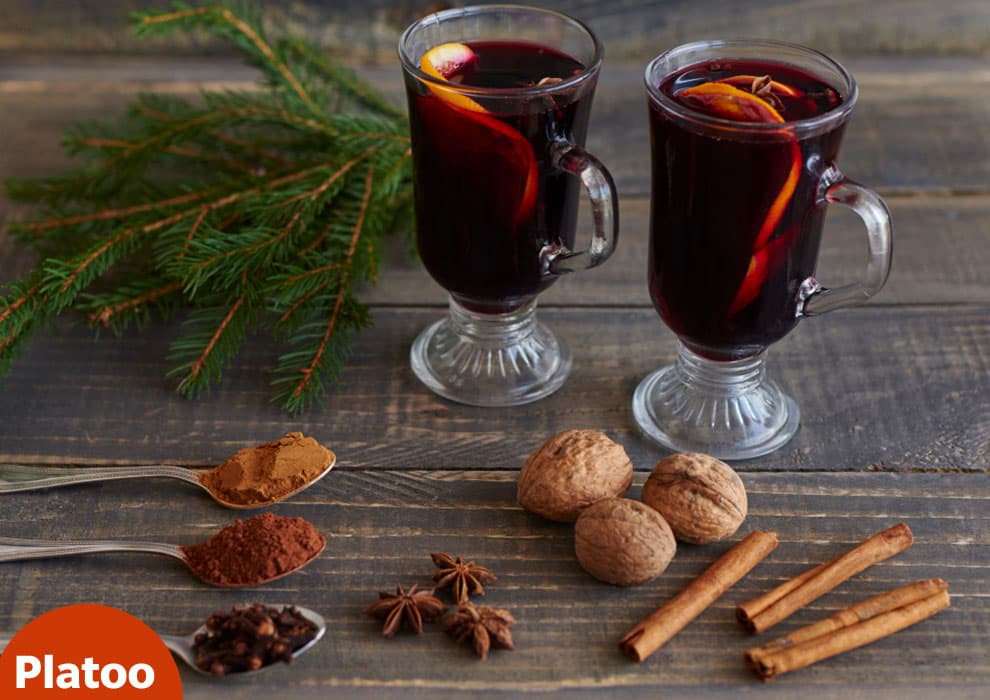
At opening time the first cup tastes warm and balanced. By evening the same pot tastes bitter, flat or syrupy, and nobody changed the recipe. The spice mix is rarely to blame; the wine, the heat and the hours spent warm usually are.
This guide follows the drink from base wine to menu board: ratios for red and white, why the pot should never boil, how to scale up with a spice syrup, how long a batch can stay hot, what a cup really costs, how to build an alcohol-free version, and what the law expects you to tell guests about allergens.
Key takeaways
- The base wine decides the result: choose a fruity, low-tannin red, because neither sugar nor spice can cover a harsh wine for long.
- Heat gently and never boil; a rolling boil drives off alcohol and flavour and can cost a German-style Glühwein its name.
- For large batches, make a concentrated spice syrup in advance and mix it with wine only in amounts you expect to sell within the next few hours.
- Rent, staff, energy and breakage weigh more on the cost of a cup than the wine itself.
- Mulled wine sold at a stall is non-prepacked, so allergen information is mandatory, and the alcohol-free version should be named and labelled as a drink in its own right.
What Makes a Good Mulled Wine Recipe for a Bar or Stall?
A good mulled wine recipe for service is one you can repeat all night: a fruity, low-tannin red wine, a short list of mulling spices, citrus and a measured amount of sugar. The drink is only as good as the wine underneath it, and sugar cannot hide a poor base for long.
Heat and spice do not mask a wine’s flaws; they amplify them, and the only fix left is more sugar, which flattens everything else.
According to Wikipedia, mulled wine is usually spiced with cinnamon, cloves, star anise, nutmeg and orange, and sweetened with sugar or honey. Germany is stricter: according to the Bavarian food safety authority (LGL), Glühwein is mainly spiced with cinnamon and/or cloves, with other flavours playing only a minor role.
Which wine should you use for mulled wine?
As for what wine to use for mulled wine, choose an affordable, jammy red such as Merlot or Grenache. According to The Mixer, top-end bottles are wasted once heated and spiced, light Pinot Noir disappears under the cloves, and tannic Cabernet Sauvignon is best avoided.
According to ZDF’s Besseresser programme, as reported by nordbayern, mass-market mulled wine at Nuremberg’s Christkindlesmarkt contained nearly 17 g of sugar per cup, against about 10 g in a vintner’s mulled wine.
Mass-market mulled wine
Nearly 17 g of sugar per cup
Vintner’s mulled wine
About 10 g of sugar per cup
The goal for a stall is not to buy expensive wine, but to buy wine you would happily drink cold.
Spices, citrus and sugar: what each one does
Cinnamon gives warmth and the smell that pulls people towards a stall. Cloves add depth but turn medicinal quickly, so they are the spice to measure most carefully. Star anise adds a faint liquorice note; use it sparingly for the German style.
Citrus adds acidity and aroma, which stop the sweetness from feeling flat. Sugar rounds off the spices and the wine’s edges, but it is the easiest ingredient to overdo.
Many venues also offer a shot of spirit on top; more on that below. If you are still planning the season as a whole, start with how to get and run a Christmas market stall.
Classic Mulled Wine per Litre: Red and White
Most bars and market stalls plan their mulled wine by the litre rather than by the bottle. A litre divides neatly into cups, scales without fuss, and is small enough to test a blend before a whole case goes into the pot. It is also the simplest way to learn how to make mulled wine that tastes the same every night: fix one litre, then multiply.
A fruity, low-tannin red such as a young Merlot, Grenache or Dornfelder stays smooth when heated, while oaky or tannic reds turn bitter.
Keep the heat at a bare simmer throughout and add any spirit only at the end, so the alcohol and aroma stay in the cup. The mulling spices are cinnamon, cloves and star anise, with orange or other citrus for brightness and sugar to balance the acidity.
According to the pub group Heartwood Inns, its mulled wine recipe combines 1 litre of red wine with 200 ml of orange juice, 200 ml of apple juice, 30 ml of brandy and 40 g of caster sugar, simmered for 40 minutes without boiling. The juices take the batch to roughly 1.4 litres and soften the wine.
Step-by-step method for one litre
- Pour 1 litre of fruity red wine into a heavy-bottomed pan with 200 ml of orange juice and 200 ml of apple juice.
- Stir in 40 g of caster sugar over gentle heat until it dissolves.
- Add cinnamon sticks, a few cloves, star anise and orange slices. Start light; spice can be added later but not taken out.
- Hold at a bare simmer for around 40 minutes, without boiling.
- Stir in 30 ml of brandy at the end, taste, and adjust the sugar or citrus.
- Strain out the spices and fruit before serving, so the drink does not turn bitter.
The brandy is optional; many stalls sell it as a separate shot instead. Scandinavian glögg usually leans sweeter, often with raisins and almonds.
How do you make white mulled wine?
White mulled wine is made the same way, with a dry or off-dry white, such as Riesling or Müller-Thurgau, in place of the red. White wine is more delicate, so it takes lighter spicing, more citrus and often a little honey.
According to the Bavarian food safety authority (LGL), Glühwein made from white wine must carry an added term indicating white wine, such as “weiß”. EU rules on aromatised wine products, published on legislation.gov.uk, require the same for white Nordic glögg (Viiniglögi or Vinglögg). If the pot is white, the name should say so.
How Hot Should Mulled Wine Be, and Why Not Boil It?
Mulled wine should be hot enough to steam in the cup but never bubble in the pot. Many operators hold it at roughly 70–75 °C, just under the point where alcohol starts to boil off; treat that as a working range rather than a rule, and check it with a probe thermometer instead of by eye.
According to Wikipedia’s entry on ethanol, ethanol boils at about 78 °C (78.23 °C), well below water’s 100 °C. Past that, alcohol leaves with the steam and the spices turn harsh.
A rolling boil costs you alcohol, flavour and, for a German-style Glühwein, possibly the right to use the name. EU Regulation 251/2014 sets a minimum alcoholic strength for Glühwein, covered in the menu section below, and heavy reduction of a light base wine can push a batch towards that line.
How much alcohol cooks off when you heat mulled wine?
Less than many people assume at first, and more than they expect over a long shift. According to the USDA’s table of nutrient retention factors, alcohol stirred into a hot liquid and taken off the heat keeps 85 % of its strength.
| Preparation method | Alcohol retained |
|---|---|
| Stirred into hot liquid, removed from heat | 85 % |
| Flamed | 75 % |
| Stirred in, simmered 15 minutes | 40 % |
| Stirred in, simmered 30 minutes | 35 % |
| Stirred in, simmered 1 hour | 25 % |
| Stirred in, simmered 1.5 hours | 20 % |
Source: USDA table of nutrient retention factors.
Below ethanol’s boiling point losses should be slower, but the longer and hotter the wine sits, the weaker it gets. Heat gently and keep a lid on.
When to add the brandy or rum shot
The Christmas market staple Glühwein mit Schuss, mulled wine with a shot of brandy or rum, works best when the spirit goes into the cup, not the pot. Poured over hot wine at serving, it behaves like the 85 % case in the table.
Typical scenario: a shot added to a simmering urn in the morning is largely gone by the evening rush.
A per-cup shot also keeps portions consistent and lets one batch suit guests who want it strong or mild.
Scaling the Batch: 10, 20 and 50 Litres
A spiced wine that tastes right in a two-litre pan rarely stays the same when it is multiplied by 25. Spices extract differently in a large volume, more liquid is lost as steam, and the vessel you heat it in sets the real limit on how much you can serve at once.
Planning starts with the cup, not the pot. According to the Nuremberg newspaper nordbayern, a cup of mulled wine at a German Christmas market typically holds about 200 ml. On paper, every litre gives roughly five cups before spills and evaporation.
| Batch size | 200 ml cups on paper | Planning figure after losses* |
|---|---|---|
| 10 L | 50 | about 45 |
| 20 L | 100 | about 90 |
| 50 L | 250 | about 225 |
*Illustrative example: assumes roughly 10 % lost to evaporation, spillage and the last litre that cannot be poured cleanly. Yours depends on equipment and service pace.
How much mulled wine do you need per day?
Multiply the cups you expect to sell by 0.2 litres, then add a margin for losses.
Illustrative example: a stall expecting 300 cups on a Saturday needs about 60 litres of finished wine, closer to 65–70 litres once waste is counted. A café expecting 40 cups over an afternoon needs about 8 litres, which fits one 10-litre batch.
The first-week figure is a guess; recording daily sales, split by weekday and weekend, turns it into a forecast within a fortnight.
At 20 or 50 litres, the more reliable method is to prepare a concentrated spice syrup in advance and combine it with wine in batches sized to what you will sell in the next few hours.
The simmered, strained base keeps the flavour consistent from first cup to last, the wine spends less time on the heat, and cloves and cinnamon are strained out before they turn bitter.
Urn, soup kettle or slow cooker: choosing the equipment
A countertop mulled wine urn is the usual choice for stalls and busy bars. A typical countertop urn holds about 5 litres and has a tap, so a 200 ml cup is poured in seconds and the lid stays closed. A 10-litre batch therefore needs two urns, or one topped up from a pot behind the counter.
A soup kettle is served with a ladle instead. It is slower during a rush, and the open surface lets more aroma escape.
A slow cooker fits a café selling a few dozen cups a day, or a kitchen preparing the spice base overnight. For 50 litres a day, most stalls combine a larger heating vessel at the back with one or two urns at the front.
How Long Can You Keep Mulled Wine Hot?
You can keep mulled wine hot for a whole service, but every hour on the heat costs you alcohol and aroma. The practical answer is to hold small batches for a few hours at most and top up from a cooler base, rather than keeping one pot hot from opening to close.
Operators tend to underestimate alcohol loss, and flavour drifts too. Below a simmer, alcohol goes more slowly, but the spices keep extracting. A wine balanced at noon can turn bitter and flat by evening.
63 °C
Minimum hot-holding temperature for cooked or reheated food
UK food hygiene regulations
2 hours
Maximum time hot food may stay out of hot holding
Food Standards Agency
8 °C
The temperature food must then be chilled to, or it is thrown away
Food Standards Agency
Hot-holding rules and a simple temperature log
Food safety sets the floor. According to the UK’s food hygiene regulations, cooked or reheated food held for service must not be kept below 63 °C. Treat mulled wine like any other hot-held item.
The working range from the temperature section above keeps you clear of that floor while staying below the boiling point of ethanol.
In the UK, the Food Standards Agency’s Safer Food Better Business guidance allows hot food out of hot holding for up to two hours, after which it must be chilled to 8 °C or below or thrown away. Rules elsewhere in the EU differ, so check with your local authority.
A thermostatic urn or soup kettle makes this manageable. Log the temperature, time and your initials every hour or at each top-up. It answers an inspector’s first question.
Making ahead: spice syrup, chilled base and same-day reheating
The easiest way to shorten hot-holding time is to separate the slow work from the quick work, as in any good restaurant kitchen organisation.
Simmer spices, sugar, citrus peel and a little water into a concentrated syrup the day before, then strain and chill it. During service, combine syrup and wine and heat only what you expect to sell in the next hour or two.
Reheat on the day, in small quantities. Wine cooled and reheated a second time loses more alcohol and tastes stewed. A batch that has sat warm for most of a shift is better poured away than rescued.
Mulled Wine Cost per Cup and How to Price It
Ask a stallholder what a cup of mulled wine costs to make and the answer is usually “very little”. That is true, and it is also the problem.
When the liquid is cheap, the price is not set by the wine. It is set by the market around you, the cup, the deposit and the queue.
What do Christmas markets charge for a cup of Glühwein?
In 2025 most German markets charged between €3.50 and €6 a cup. According to Reisereporter’s price index, as reported by web.de, the cheapest Glühwein was €3.50 in Dortmund, Augsburg, Braunschweig and Mannheim, while Munich and Berlin reached €5–6. Nuremberg’s Christkindlesmarkt kept its cup at €4.50, unchanged from 2024, according to nordbayern, with berry versions at €5.
Austria sits higher. A vienna.at comparison from December 2024 found Glühwein at the Rathausplatz market between €5 and €7.50, averaging about €6.25.
Portion sizes vary, so compare price per millilitre, not per cup.
Pour cost formula with a worked 10-litre example
Pour cost is the ingredient cost per serve divided by the selling price excluding VAT. Use the net price, because the VAT part of what the guest pays is not yours.
A 200 ml cup is the usual market portion, and a 10-litre batch gives roughly 50 such cups before waste and evaporation.
Illustrative example: pour cost of a 10-litre batch
Prices are assumed, not quoted. Base wine at about €2.50 a litre wholesale, the figure ZDF’s Besseresser programme cited for mass-market mulled wine according to nordbayern, comes to €25 for 10 litres. Add an assumed €6 for sugar, spices and oranges, and the batch costs €31. Allowing for loss, say 46 cups reach guests. That is about €0.67 per cup. Sold at €4.50 including an assumed 19 % VAT, the net price is about €3.78, so the pour cost is roughly 18 %.
The wine is rarely the expensive part of a cup of mulled wine; rent, staff, energy and breakage are. An 18 % pour cost looks generous until you add the stall fee, gas or electricity, napkins and staff hours.
Run the sum with your own invoices and VAT rate, then check it against the restaurant menu pricing methods and margin formulas you use elsewhere. A marked ladle, which stops overfilling, protects the margin more than haggling over wine.
Should you charge a mug deposit?
Yes, if the market allows it, and in many places it decides for you. In Nuremberg, according to nordbayern, the €5 mug deposit (Pfand) is set centrally by the market’s cup pool, not by each stall. Vienna’s Rathausplatz also charged €5 in December 2024, while Spittelberg asked €3, according to vienna.at. Some French markets, Strasbourg among them, have used a deposit of around €1 in recent seasons.
A deposit is not income, but it cuts breakage and makes souvenir cups pay for themselves.
Show it separately from the drink price so the €4.50 does not read as €9.50. Rules differ by organiser, so check them before printing the price board.
Non-Alcoholic Mulled Wine and Kinderpunsch
Every stall that sells hot wine hears the same question several times an evening: is there something for the children, the driver, the guest who isn’t drinking?
A “no” can send the whole group to the next hut; a zero-proof pot keeps it at your counter.
At German Christmas markets the answer has a name. According to Wikipedia, Kinderpunsch is a non-alcoholic spiced punch served to children. It is not a watered-down Glühwein, and under EU naming rules it cannot be one. The alcohol-free cup is its own drink, built on juice and tea, and it should be named and labelled that way rather than sold as a lighter wine.
How do you make alcohol-free mulled wine?
To make non-alcoholic mulled wine, replace the wine with a fruit base and keep the mulling spices. A common mix is red grape juice with black or hibiscus tea, some apple or orange juice for body, and orange slices. Add cinnamon, cloves and star anise, and sweeten only after tasting.
The tea supplies the tannin juice lacks, so the cup doesn’t taste like warm cordial.
Hold it below a simmer; spices turn bitter in boiling juice too. Give it a separate pot, ladle and label.
Pricing the zero-proof cup next to the wine
Guests compare the two cups side by side, so the gap matters more than the absolute price.
| Market | Drink | Price per cup |
|---|---|---|
| Nuremberg, 2025 | Punch, including children’s punch | €3.50–4 |
| Vienna Rathausplatz, December 2024 | Kinderpunsch | about €4.50 |
According to nordbayern.de, punch at Nuremberg’s market in 2025, children’s punch included, cost €3.50–4 per cup. According to vienna.at, Kinderpunsch on Vienna’s Rathausplatz cost about €4.50 in December 2024. Neither market treats the alcohol-free cup as a cheap afterthought.
Illustrative example: if your wine sells at a notional €5, a Kinderpunsch at €4 stays visibly cheaper while still covering juice, tea and spices. Work from your own costs.
How Should Mulled Wine Appear on Your Menu: Name, Allergens and Languages?
Mulled wine should be listed under a name that matches what is actually in the cup, with sulphites declared and any nut garnish flagged, plus a local name guests from abroad will recognise. The same fields apply to every line of a drinks menu template.
What can legally be called Glühwein?
Only a drink made from wine that meets a few minimums. According to Annex II of Regulation (EU) No 251/2014, Glühwein is obtained exclusively from red or white wine, must have an actual alcoholic strength of at least 7 % vol, and may not have water added. A batch stretched with water or juice belongs on the menu as “mulled wine” or “spiced punch”.
The Bavarian food authority LGL found 7 of 78 Glühwein samples tested in 2016/2017 (about 9 %) objectionable; two fell below 7 % vol.
The EU’s 2025 wine package (COM(2025) 137) proposed opening the Glühwein name to fermented drinks made from fruits other than grapes, and it has since moved through adoption. Before labelling a fruit-based version as Glühwein, check the final text in EUR-Lex.
Do you need to declare sulphites for mulled wine?
In practice, yes. According to Annex II of Regulation (EU) No 1169/2011, sulphur dioxide and sulphites must be declared once total SO2 exceeds 10 mg per litre, which commercial wine typically exceeds. The same LGL round found one sample above the 200 mg/l limit.
Article 16(4) of 1169/2011 exempts drinks above 1.2 % vol from an ingredients list and nutrition declaration, but not from allergen information. Because mulled wine poured at a Christmas market stall is non-prepacked, Article 44(1)(a) makes allergen information mandatory, whatever its strength.
Garnishes count too. Almonds and other tree nuts, common in glögg-style serves, are listed allergens. For the full list, see the 14 allergens EU law requires on your menu, and for the practical side, showing allergens on every item of a digital menu.
Seasonal listing, price changes and translations for tourists
Mulled wine is a seasonal item, so decide in advance when it goes on, when it comes off and who changes the price, as described in updating seasonal dishes, prices and availability.
Listing the name tourists know from home next to the English one saves questions at the counter.
| Country or region | Local name |
|---|---|
| Germany, Austria | Glühwein |
| Nordic countries | Glögg |
| France | Vin chaud |
| Italy | Vin brulé |
| Poland | Grzaniec |
| Czech Republic | Svařák |
| Bulgaria | Greyano vino |
“Glühwein” carries the legal definition above in any language, so a non-alcoholic or water-based version should not borrow it.
In a digital menu like Platoo, price changes go live straight away, the QR code stays the same, and a sold-out item can be hidden. Translations are automatic and editable by hand, which is useful for names like svařák.
To see how a translated drinks list looks on a guest’s phone, open an example menu, no sign-up needed.
Your Mulled Wine Recipe Checklist for the Season
Before the first market weekend, go through every decision once, in order, rather than fixing problems at the stall with a queue waiting. Each step below matches a section of this guide.
- Lock in one recipe per litre, red and white, and write it down so every shift makes the same drink.
- Test the scaling at your real batch size, whether 10, 20 or 50 L, and taste it before service.
- If you sell it as Glühwein, check the legal name rules and the strength of the finished batch.
- Set a hot holding routine: keep it at 63 °C or above and log temperatures through the day.
- Recalculate cost per serving and pour cost with this season’s wine and spice prices.
- Update the menu: names, allergens and languages.
A recipe only pays if the cup you pour at 9 pm matches the one you tested in October.
If you are still sorting out permits and pitch fees, see our guide on how to get and run a Christmas market stall.
Get your winter drinks menu ready
Create a free Platoo QR menu for your stall or bar, add mulled wine and the alcohol-free cup with their allergens, and change prices during the season without reprinting the QR code.
Start for freeRelated reading
Frequently Asked Questions
About 45 cups, if you serve the 200 ml portion typical at German Christmas markets. On paper 10 litres fills 50 cups, but some volume evaporates during long heating, and spillage, tasting and topping up the urn all take a share. Illustrative example: allowing 10 % loss leaves about 45 full cups.
Yes, partly. Ethanol boils at about 78 °C, so a pot kept hot slowly gives off alcohol, and the longer it heats, the more is lost. USDA retention data show that after an hour of simmering about 25 % of the alcohol remains. Even so, treat every cup as an alcoholic drink.
Yes, if it was cooled quickly and kept in the fridge overnight. Strain out the fruit and spices before storing, or the drink turns bitter. Reheat gently without boiling, and if you hold it for service, keep it above the legal hot-holding minimum. Expect a slightly flatter flavour.
A soft, fruity, unoaked red with low tannin. Heat and spice exaggerate harshness and oak, so a bitter wine only gets worse in the pot. Paying more brings little benefit once sugar and citrus go in. Taste the base cold before buying in bulk: if you would not drink it, do not mull it.
Price it against nearby competition, checked against your pour cost. For reference, German markets mostly charged between €3.50 and €6 a cup in 2025, with Austrian markets higher, and a mug deposit usually comes on top. Work out your cost per cup, then make sure the price covers staff, energy and pitch fees as well as the wine.
Yes, almost always sulphites, because wine contains sulphur dioxide and EU rules require it to be declared above 10 mg per litre. Drinks over 1.2 % vol need no ingredients list, but allergen information still applies. Check additions too: nut liqueurs, flavoured syrups or ready-made spice mixes may bring further allergens to declare.