
Christmas Quiz Night: Questions, Rounds and How to Host
Plan a Christmas quiz night that fills quiet tables: ready-made rounds, questions with answers, prize and music licence rules, and what to serve between rounds.
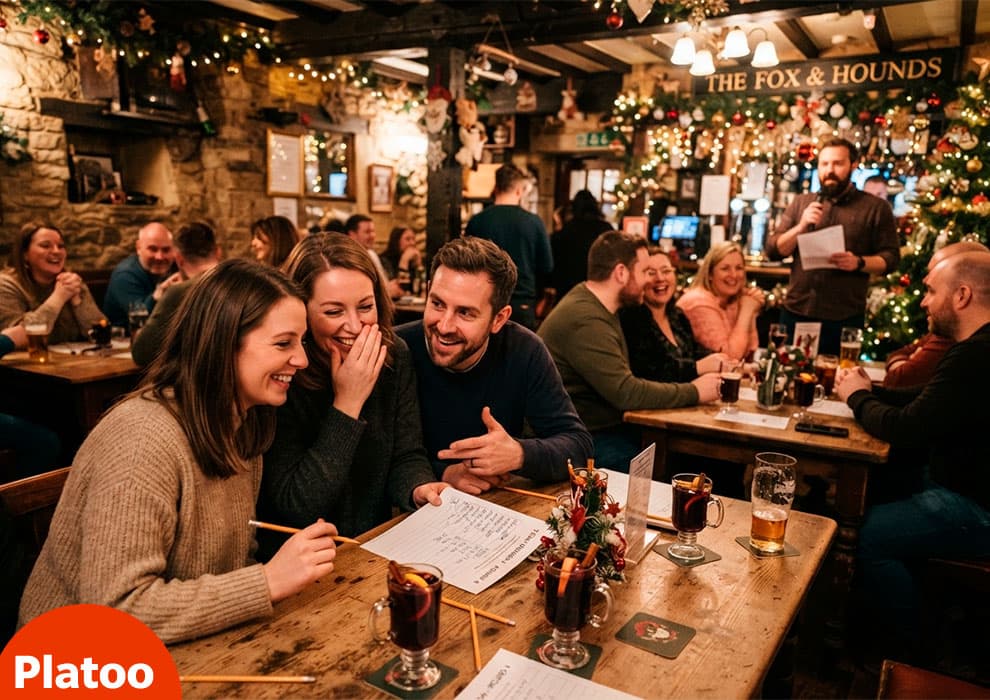
December brings in people you rarely see together. Colleagues. Neighbours. Old school friends home for the holidays. They want an evening out, but not every group wants to spend it just eating and making small talk.
A Christmas quiz gives that table a shared job. Teams sit together, compete over several rounds and order food and drinks in between.
This guide is the practical version, for a pub, restaurant, café or hotel bar. You’ll find how to structure the night, how many rounds to run and how to keep phones from deciding the winner. There are also three ready-made rounds with answers, the legal points on prizes and music, and advice on food, mixed-language teams and promotion.
Key takeaways
- The quiet midweek slot in December is where a Christmas quiz night does its most useful work.
- Plan the breaks between rounds first: that is when marking happens and the bar gets busy.
- Picture, audio and video rounds are harder to look up on a phone, so they protect the scoreboard.
- Prize, lottery and music licensing rules differ in every EU country, so check national law beforehand.
Why a Christmas Quiz Fills Quiet December Weeknights
You probably know the pattern. Fridays and Saturdays in December book up weeks ahead with office parties. Then an early-December Tuesday arrives and feels like any other winter weeknight.
That gap between packed weekends and a half-empty midweek is where a quiz night earns its place.
The idea isn’t new. Hospitality guidance has long described quiz nights as a way to raise footfall, keep guests at the table longer and lift spend on the quieter nights of the week. Teams arrive together, settle in and buy food and drinks between rounds, instead of leaving after one pint.
A Christmas quiz turns that weekly habit into a seasonal event that groups plan around. It suits people already looking for a reason to meet: colleagues heading out straight after work, or friends marking the end of the year before everyone travels home. Nobody has to give a speech or run the entertainment.
The quiet midweek slot is where a festive quiz does its best work.
There’s a longer game, too. Venues that run trivia on a fixed night find it becomes a reliable source of mid-week traffic, and December is a good moment to introduce the format to guests who may come back in January.
Because teams arrive as a group, many venues take a group booking with a small deposit per table. That cuts no-shows on exactly the nights when every table counts.
How Do You Host a Quiz Night Step by Step?
Make four decisions well in advance: who runs it, how teams record their answers, how the evening is paced and how scoring works. Settle those, and the questions do the rest.
Pick the night first. Choose a weeknight that avoids your busiest service, and fix a team size; four to six players is a common format.
Write the rounds a week ahead. That gives the quizmaster time to read the Christmas quiz night questions aloud and cut anything ambiguous.
Promote once the format is set: posters by the bar, a post on social media and an A-board outside.
How many staff do you need to run a quiz night?
Typically, two people beyond normal service. The quizmaster (host) reads the questions, keeps time and rules on disputes.
A second person collects answer sheets and marks them while the next round is read, so the host never stops to add up scores.
Should teams answer on paper or on their phones?
For most venues, paper still works best. The classic British pub quiz is typically built on paper answer sheets, often across six to eight rounds of ten questions. One sheet per round makes marking quick and disputes easy to settle.
Phones invite looking answers up. Ask teams to keep them face down during rounds, and say it the same way every time: “Phones face down, please. The only screen you need tonight is the picture sheet.” Picture and audio rounds also make searching harder.
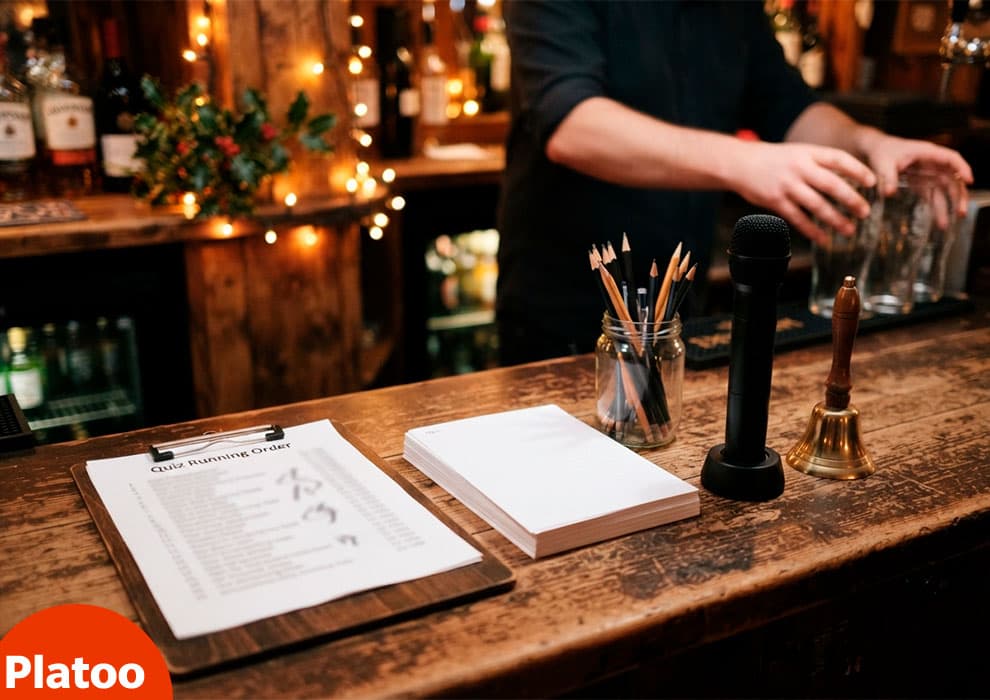
A sample running order for a 2.5-hour Christmas night
This plan uses four spoken rounds plus a picture round that sits on the tables from the start rather than taking its own slot. Fix the timings before doors open and give the host a printed copy, so every round starts when the room expects it.
- 19:00 – Doors open; teams register, choose a name and collect answer sheets and the picture round.
- 19:30 – Round one, then a ten-minute break; picture sheets are collected.
- 19:55 – Round two, then a short break.
- 20:20 – Round three, then the longest break, about 20 minutes, for food.
- 21:00 – Round four, an audio or music round.
- 21:20 – Final scores read out in reverse order, then prizes.
- 21:30 – Close, with the next quiz date announced.
Read running totals after each round. Trailing teams stay interested until the end.
How Many Rounds and Questions Should a Pub Quiz Have?
For most venues, four quiz rounds of ten questions plus a picture round fill an evening without losing the room. The classic British pub quiz often runs longer, but a festive crowd that is also eating and drinking usually prefers a tighter format.
A Brighton pub profiled in the trade press runs four rounds with a food and drink break between each. The picture round sits outside that count: it is handed out at the start and collected near the end, so teams have something to puzzle over during the breaks.
| Format | Rounds (plus picture round) | Questions | Suits |
|---|---|---|---|
| Standard evening | 4 | 40 | Most venues, early finish |
| Longer evening | 5–6 | 50–60 | Regular quiz crowd |
| Classic long | 6–8 | 60–80 | Dedicated quiz pubs |
How long should a pub quiz last?
A common format runs two to two and a half hours, breaks included. A round of ten questions typically takes 10–15 minutes, plus a few minutes for marking.
Plan the breaks before the questions, because the pauses between rounds are when the bar gets busy. Finishing before the last buses leave keeps teams coming back.
Scoring, jokers and handling disputes
Keep the answer sheet and scoring simple: one point per correct answer, with half points only if announced at the start.
Many hosts let each team play a joker on one round to double its score, marked on the sheet before the round begins. Swapping sheets between neighbouring tables speeds up marking, while the quizmaster keeps the running total.
Say before round one that the quizmaster’s decision is final, including on disputed spellings and alternative answers. Keep a tie-breaker question ready in case two teams finish level.
8 Christmas Quiz Round Ideas That Work in a Busy Venue
A round that works in a quiet function room can fall apart on a Friday, when the bar is three deep. In a busy venue, quiz rounds need little explanation, survive interruptions and can be marked quickly.
The eight ideas below fall into two groups: rounds that suit any crowd, and rounds that make a phone search pointless. Choose four for a weeknight, or five to six for a longer evening.
Rounds for mixed groups, office parties and families
An office party table and a family of five want different things. So the safest rounds reward general knowledge and good guesswork, not specialist recall.
| Round | How it works | Why it suits mixed tables |
|---|---|---|
| Christmas traditions in Europe | One custom per question; teams name the country | Everyone has a holiday memory to draw on |
| Festive food and drink | Dishes, desserts and the drinks of the night, mulled wine included | Easy to tie to what is on the bar |
| Christmas markets | Match a market to its city or a stall to its speciality | Rewards travellers and locals alike |
| True or false | Short festive statements, answered in seconds | Children can play as equals |
| Local round | Christmas customs, lights and landmarks of your own town | Regulars finally beat the visitors |
European Christmas traditions make the best questions when the answers carry a story. Denmark’s risalamande, the rice pudding that hides one whole almond with a small prize for whoever finds it, is the kind of custom teams retell after the scores are in.
Rounds that keep phones in pockets
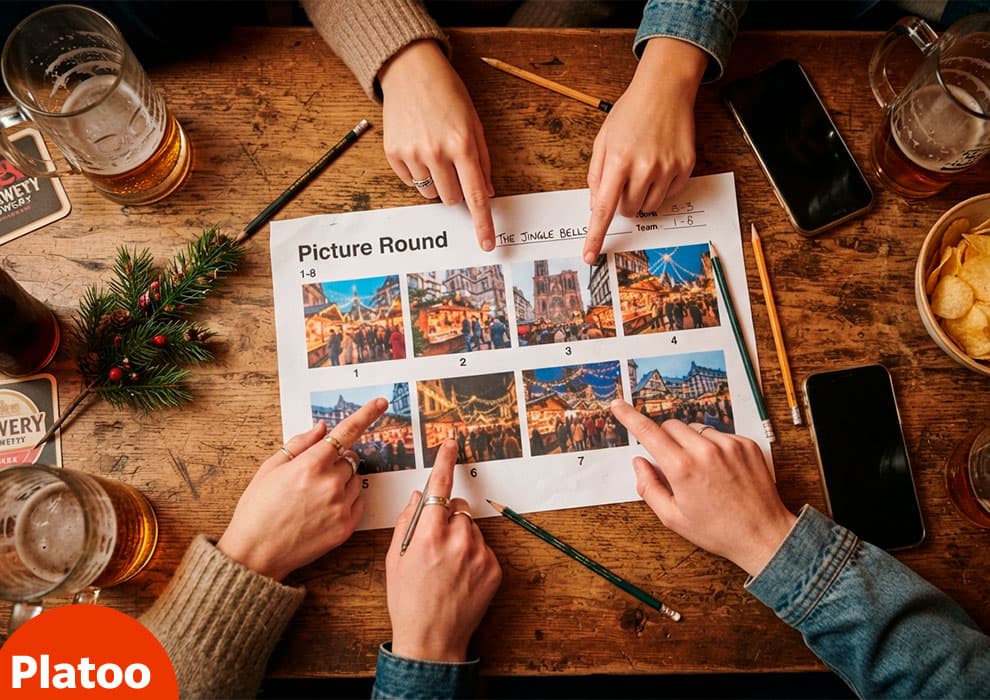
The picture round runs alongside the main rounds of any Christmas quiz rather than counting as one. Hand the sheet out at the start of the night and collect it near the end. Teams go back to it whenever the host is marking.
Picture, video and audio rounds are harder to look up on a phone than a typed question, which is why they protect the scoreboard. A blurred film still or a cropped landmark photo can’t be pasted into a search bar.
The music round works the same way: play the first seconds of a carol or a Christmas hit and ask for title and artist. A silent film-scene round on the sports screens adds variety without extra kit.
For lighter interludes, the same principles apply to party games and activities for restaurants and bars.
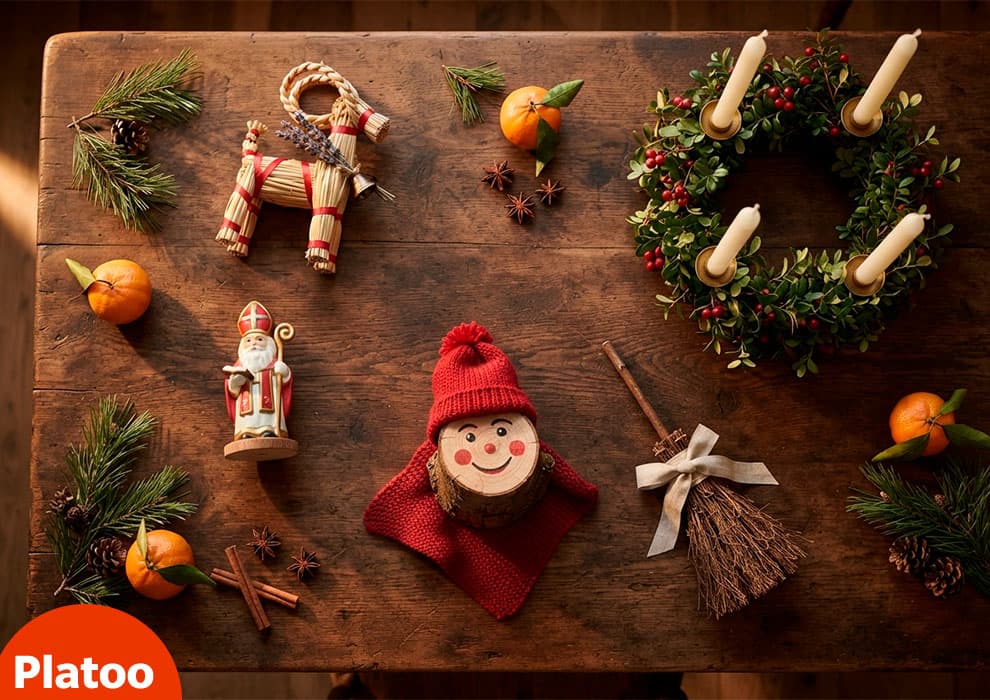
Round 1 – Christmas Around Europe: Questions and Answers
Every country in Europe tells the Christmas story a little differently. That makes a gentle opening round. These ten Christmas quiz questions and answers cover gift-bringers, dates and odd local customs, so a table of tourists has as fair a chance as a table of regulars.
| # | Question | Answer |
|---|---|---|
| 1 | In the Netherlands, Sinterklaas traditionally arrives by steamboat from which country? | Spain |
| 2 | On what date do Dutch families celebrate Sinterklaasavond, St Nicholas’ Eve? | 5 December |
| 3 | Which kindly witch brings gifts to Italian children on the night before Epiphany? | La Befana |
| 4 | On what date is St Lucia’s Day celebrated in Sweden? | 13 December |
| 5 | How many Yule Lads (Jólasveinar) visit Icelandic children before Christmas? | 13 |
| 6 | In Poland, what must appear in the sky before the Wigilia supper on Christmas Eve can begin? | The first star |
| 7 | Which horned figure accompanies St Nicholas in Austria and Bavaria on the night of 5 December? | Krampus |
| 8 | What is the name of the Catalan Christmas log that children “feed” and beat until it gives out sweets? | Caga Tió |
| 9 | Which saint brings presents to Greek children on 1 January? | Agios Vasilis (Saint Basil) |
| 10 | Which city has given London the Trafalgar Square Christmas tree every year since 1947? | Oslo |
Read each question twice, slowly. Give the country before the detail, so mixed-language teams catch the key word.
Accept close spellings. “Befana” or “Caga Tio” count, and so does “Tió de Nadal” for question 8: you’re testing knowledge of Christmas traditions in Europe, not typing. For question 9, accept the Greek name or Saint Basil.
Decide your marking rules before the first question and announce them once, because arguing about spelling mid-round costs more goodwill than any wrong answer. Half points suit near misses, such as “Norway” for question 10.
Keep two tie-breakers in reserve; the closest number wins. In which year is Dresden’s Striezelmarkt first recorded? 1434. In which year did Gävle first build its giant straw Yule goat? 1966.
While you mark, fill the pause with a short aside, such as the Polish custom of laying an extra place at the Wigilia table for an unexpected guest.
Round 2 – Festive Food and Drink: Questions and Answers
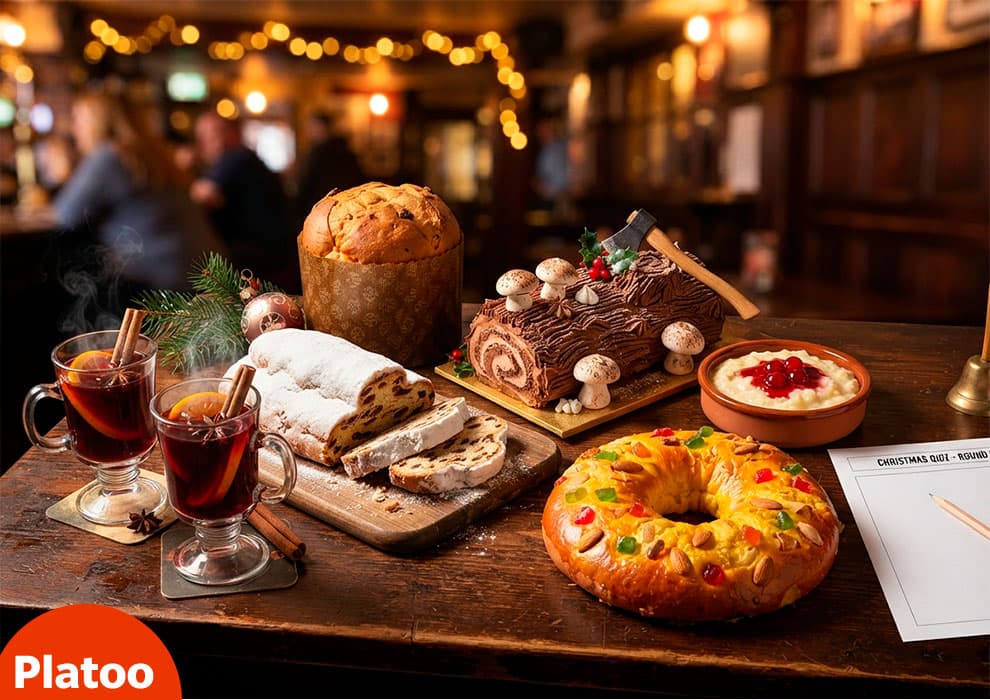
Food is the round where every table has a fighting chance. These quiz questions and answers cover Christmas traditions in Europe through what people eat and drink, from the mulled wine sold at Christmas markets to cakes that appear only in the festive season.
| # | Question | Answer |
|---|---|---|
| 1 | What do Germans call the hot spiced wine sold at their Christmas markets? | Glühwein |
| 2 | What is the same drink called in Sweden? | Glögg |
| 3 | Which German city is most closely associated with Christstollen? | Dresden |
| 4 | Panettone comes from which Italian city? | Milan |
| 5 | What is the name of France’s log-shaped Christmas cake? | Bûche de Noël |
| 6 | Which fish, usually fried and served with potato salad, is the centrepiece of Czech Christmas Eve dinner? | Carp |
| 7 | In Spain, how many grapes do people eat at midnight on New Year’s Eve? | Twelve, one for each stroke of the clock |
| 8 | What is hidden in a bowl of Danish risalamande? | One whole almond |
| 9 | What is the decorated “Christ’s bread” baked in Greece for Christmas called? | Christopsomo |
| 10 | Portugal’s Bolo-Rei Christmas cake is shaped like what? | A crown (also accept a ring) |
For questions 1 and 2, also accept “Gluhwein”, “glogg” and “gløgg”.
Time the round to the bar. If you’re pouring mulled wine that evening, read questions 1 and 2 just before the break, when guests head for a refill.
The strongest food question is often one about your own menu, because no team can have revised for it. Swap a row for a dish you serve, such as the spice in the house mulled wine, and check the answer with the chef first (chefs have opinions about their spice blends).
Round 3 – Carols, Films and History: Questions and Answers
These quiz questions and answers mix carols, classic stories, a family film and two history questions. They also double as a quieter music round.
| # | Question | Answer |
|---|---|---|
| 1 | In which Austrian town was “Silent Night” first performed? | Oberndorf |
| 2 | Which French composer wrote the music for the carol “O Holy Night”? | Adolphe Adam |
| 3 | “Carol of the Bells” is based on which Ukrainian song? | “Shchedryk” by Mykola Leontovych |
| 4 | Which Christmas song was the first played in space? | “Jingle Bells” (Gemini 6A crew) |
| 5 | Who composed the ballet The Nutcracker? | Pyotr Ilyich Tchaikovsky |
| 6 | In which city did The Nutcracker premiere? | St Petersburg |
| 7 | Who wrote A Christmas Carol? | Charles Dickens |
| 8 | In Home Alone, which city is the McCallister family flying to? | Paris |
| 9 | Which ruler was crowned emperor in Rome on Christmas Day 800? | Charlemagne |
| 10 | During which war did the Christmas Truce take place? | The First World War |
For question 10, accept “WWI” or “the Great War”.
Tie-breaker questions with number answers
A tie-breaker question with a number answer settles a draw without argument: the closest guess wins, and two teams rarely land on the same figure.
Start with the total number of gifts in “The Twelve Days of Christmas”, counting every gift on every day, repeats included: 364. Say the counting rule out loud, or someone will answer 78 and be furious.
Backups: the year “Silent Night” was first sung (1818), the year Dickens published A Christmas Carol (1843) and the year the ballet The Nutcracker premiered (1892).
Is a Pub Quiz With Entry Fees, Prizes and Music Legal?
Usually yes, provided the quiz tests knowledge, the money side stays simple and the music is licensed. Each country sets its own rules, so the British example below is an illustration, not a template for the EU.
Are entry fees and cash prizes allowed at a pub quiz?
In Great Britain, the Gambling Commission treats a quiz as a prize competition when the outcome is determined by participants’ skill, judgement or knowledge. One that meets the requirements of the Gambling Act 2005 needs no licence or permission from the Commission, so an entry fee and a cash prize may be allowed, provided the result depends on knowledge rather than chance.
Multiple-choice questions rarely meet the skill test, the Commission notes, and a competition that fails it may be treated as an illegal lottery. Open questions with one correct answer are safer.
Raffles and bingo are different. Equal chance gaming in alcohol-licensed premises does not allow participation fees charged by the pub, and bingo there is capped at £2,000 per week in stakes and/or prizes without an operating licence.
Open questions, an entry fee, a prize for the top score – a prize competition under British rules.
Multiple-choice guesswork or a paid side draw – at risk of being an illegal lottery.
Do you need a music licence for a quiz music round?
In Great Britain, usually yes. PPL PRS, which issues TheMusicLicence and is equally owned by PPL and PRS for Music, lists music segments in a pub quiz among the uses that need one.
Elsewhere, each country has its own collecting society. In Germany, GEMA expects public music use at hospitality events to be registered in advance, and one-off events are invoiced separately from background music. France has SACEM, Italy SIAE, Spain SGAE and Poland ZAiKS.
Every EU country sets its own rules on lotteries, prize competitions and music licensing, so check national law and the local collecting society before the first Christmas quiz night.
Can alcohol be a quiz prize?
Often, but with care. In England and Wales, the mandatory licensing conditions treat free or discounted alcohol as an irresponsible promotion when it rewards buying and drinking alcohol within a short period. A bottle of wine taken home is not the same as shots drunk on the spot.
Responsible alcohol promotion rules vary across the EU, so local licensing guidance decides what is acceptable. Food vouchers or a festive hamper sidestep the question.
This is general information, not legal advice.
What Should You Serve on Quiz Night?
Serve food teams can eat with one hand between rounds, and a short list of drinks the bar can pour fast. At a quiz night, people want to talk and argue over answers. Let the menu follow that rhythm.
A short quiz-night menu built around the breaks
Keep the menu to a handful of items. Each should go out during the breaks, be easy to share, quick to plate and simple to explain when a team asks what’s on the board.
Lean on sharing platters and bar snacks. A board of cheese and cured meats or a tray of mini pies can feed a whole team without cutlery.
Pick one drink of the night. A trivia night works best paired with a menu and drink special, so choose one, such as mulled wine, and price it simply.
For groups that book ahead, pubs and restaurants can sell a festive package: a festive set menu, drink pairings, decorations and the quiz as entertainment. For more, see these festive set menu ideas for the end of the year.
How do guests check allergens in a dark, busy room?
Under EU food information rules, a venue must provide information on the 14 listed allergens for food that is not prepacked, quiz night or not. The difficulty is practical: the lights are low and staff are busy.
Typical scenario
A guest with a nut allergy wants the sharing platter, but the server is collecting answer sheets mid-round. If the ingredients are on a menu the guest can open on their phone, they check it themselves and only ask staff to confirm.
A menu guests can read on their own phones answers the allergen question before the next round starts. A digital QR menu such as Platoo organises a venue’s menu and shows it to guests on their own phones; each dish can carry its ingredients and the 14 EU allergens. Platoo doesn’t take orders; staff do. It is worth checking how allergen labels on a digital menu are set up before the first quiz.
How Do You Run a Quiz Night for Tourists and Mixed-Language Teams?
Run it in two languages. Read every question in the local language and in English, and hand out sheets that carry both. Mixed teams then compete on knowledge, not vocabulary.
Bilingual question sheets and language-neutral rounds
The fairest rounds for international teams are the ones where language barely matters. A picture round of festive markets, instrumental carols or a “which country?” round on Christmas traditions in Europe works whether a table speaks Greek, German or Polish. Visitors may even have the edge: a Swedish team knows its own Lucia customs better than the locals do.
For written rounds, print each question in both languages on the same line and accept answers in either.
Not this: “Which festive bird does Scrooge send round on Christmas morning, cheeky so-and-so?” But this: “In A Christmas Carol, what does Scrooge buy for the Cratchits on Christmas morning?” Short wording, no puns, no idioms, no local celebrity names.
Mixing tourists with regulars also fills tables that would otherwise sit half empty.
The same logic applies to food and drink. Guests who can’t read the menu between rounds tend to point, guess or skip food; our piece on what restaurants lose when tourists can’t read the menu looks at that cost.
A QR code menu such as Platoo covers that part: guests open it on their own phone, Platoo translates the menu automatically into the languages the venue enables, and every translation can be edited by hand. It is not a quiz tool, with no answer collection, voting or leaderboard; Platoo doesn’t take orders, staff do, and guests pay the venue as usual.
To see what guests get on their phone after the scan, open an example menu — no sign-up needed.
How Do You Promote a Quiz Night and Fill Every Table?
Start promoting three to four weeks out, and treat every team as a booking rather than a walk-in. A quiz night announced early and booked in advance fills the room on quiet weeknights, exactly where it lifts footfall, dwell time and spend. For the wider picture, see our guide on how to attract more customers to your restaurant.
Layer the promotion. A workable order:
- Put posters on the door and behind the bar four weeks before, with the date, start time, entry fee and prizes.
- Chalk the A-board outside the week before and on the day.
- Post on social media weekly, then share a sample question two days before.
- Ask regulars to round up their teams and take group bookings by name.
For large December parties, a modest deposit on group bookings reduces the risk of a reserved table left empty all evening.
Should you charge per team or per person?
Charging per person usually means a small fee that feeds the prize pot, and it scales with team size. A per-team fee is quicker to collect but invites oversized teams. Either way, state the fee clearly on every poster.
Turning one December quiz into a January regular
The lasting value of a Christmas quiz is the weeknight habit it can start. A recurring trivia night is a steady way to drive mid-week traffic, and January is when that traffic is hardest to find.
Before the final scores, announce the next date: “Same table, same teams, second Tuesday in January?” Then hand every team a card with the January schedule.
That December Tuesday that felt like any other weeknight? It can become the night your regulars plan around.
Put your quiz-night menu on guests’ phones
Create a free Platoo account, add the food and drinks you serve between rounds and put the QR code on every quiz table, so guests can check dishes and allergens on their own phones.
Start for freeRelated reading
Frequently asked questions
Typically 40 to 60 questions: four rounds of ten plus a picture round for a weeknight, or five to six rounds for a longer evening. Hand out the picture round at the start so teams can work on it while drinks arrive. Keep the other rounds a similar length so teams can pace themselves and marking stays quick.
Typically a small fee per person, often close to the price of a soft drink or half a pint. The fee should feel token rather than a barrier, because the venue earns from food and drink, not entries. Charging per person keeps large and small teams on equal terms. Check local rules before pooling fees into a cash prize.
A bar tab, a voucher for a meal or a festive hamper usually work best. Prizes like these bring the winners back to the venue rather than sending them home with cash. A bottle of house wine suits smaller teams. Add a small booby prize for the last-placed team; it keeps the mood light and gives the room a laugh.
It depends on the country. In Great Britain, a quiz is generally treated as a prize competition rather than gambling, because the result depends on knowledge, not chance. Raffles or tie-breakers decided by luck can change that. In EU countries the rules vary, so check national law or ask your licensing authority before charging entry.
Typically a Tuesday, Wednesday or Thursday, when tables would otherwise sit empty. Mondays can be slow to fill, while Fridays and Saturdays are usually busy without help. Pick one night and keep it fixed, because regular teams plan around a predictable slot. In December, avoid clashing with local Christmas markets or office party nights.
Yes. Any confident member of staff or a regular can host, provided they prepare in advance. Write or source the questions, check every answer and rehearse reading them aloud. A clear microphone, printed answer sheets and a second person to mark papers matter more than experience. Ready-made question packs make the job easier still.
Sources: UK Gambling Commission — Free draws and prize competitions · UK Gambling Commission — Equal chance gaming in clubs and alcohol-licensed premises · PPL PRS — TheMusicLicence for pubs and bars · IHK — GEMA in der Gastronomie · legislation.gov.uk — Mandatory licensing conditions for alcohol sales (SI 2014/2440) · EUR-Lex — Regulation (EU) No 1169/2011 on food information to consumers · European Commission — Dresdner Christstollen (PGI) · Visit Gävle — The Gävle Goat · Britannica — The Christmas Truce