
Where Restaurants Lose Customers: From the First Phone Search to the Second Visit
Restaurant customer retention starts before the second visit. Follow the guest journey from the first phone search: an outdated menu on Google, a menu tourists cannot read, PDF menus, missing allergen information, and the service, food and cleanliness leaks no menu can fix.
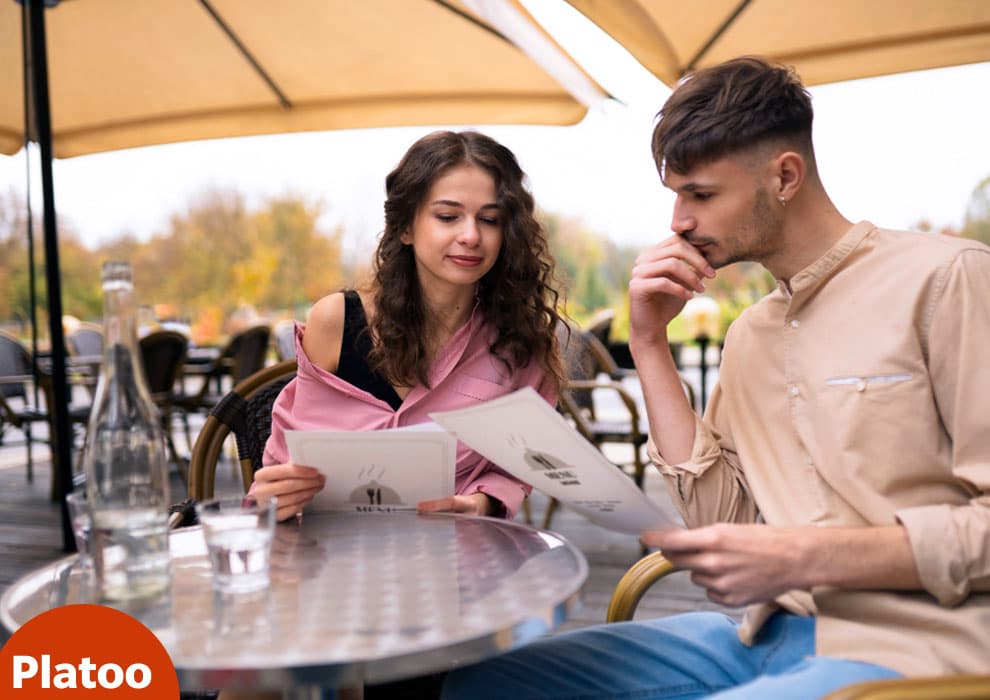
Where restaurants lose customers: a map of the guest journey
Imagine a couple on a city break standing outside a restaurant. The menu in the window is in a language they cannot read. The place next door has a page they can read. They walk on.
Nobody records that loss. The restaurant never counted those two as guests, so it never counts them as lost. Most talk about customer churn in restaurants misses this: it starts when the guest is already seated, and by then some guests are gone.
The journey in six moments
A guest journey is a chain of small decisions, and a venue can lose the guest at any one of them. There are six: the search, the choice between venues, arriving and reading the menu, deciding what to order, the meal itself, and the reason to return.
The first moment usually happens on a screen. According to Eurostat’s news item “People online in 2024”, 93% of people aged 16 to 74 in the EU had used the internet in the previous three months. That figure covers internet use in general, not restaurant search. Still, it means many first impressions of a venue now form on a phone.
Each moment below is marked by how far a menu can help: yes, partly or no.
- Search: partly
- Choosing between venues: partly
- Arriving and reading the menu: yes
- Deciding what to order: partly
- The meal itself: no
- The reason to return: no
Why most advice stops at the table
Advice on restaurant customer retention usually begins once the guest sits down. The industry commentary we reviewed agrees on the main reasons guests do not return: service quality and staff attitude, cleanliness and food quality.
One caveat applies wherever this article repeats that list. We found no first-party European data that ranks these causes. It is commentary, not measurement.
All four causes belong to the meal, which is only one moment of six. Two other forces run through the whole journey. Word of mouth carries the verdict on a meal to people who have not searched yet. Pricing and value perception shape every step, and a menu can display a price but cannot make it feel fair.
What a menu can and cannot fix
The sections below follow the journey in order and say how far a menu reaches at each step. At the door, it reaches far. At the search and the order, it reaches partly. At the meal and the reason to return, it does not reach at all. Service quality, food, cleanliness and waiting times remain large leaks that no menu fixes.
A disclosure before we start: this article is published by platoo.io, a QR menu service that only shows a menu. It has no ordering, payments, reservations or loyalty programs. The scorecard near the end credits a menu only with the leaks it can actually reach.
Before the visit: the phone search that never becomes a table
Two people step off a train in an unfamiliar town, and one of them types “dinner nearby” into a phone. Within a minute they have picked a table, before seeing any dining room. The venues they skipped never learn why. The guests simply never arrive.
How guests pick a place on their phone
The same Eurostat release lists finding information about goods and services among the everyday things Europeans do online. The data is not about restaurants, but it explains why a guest’s first contact with a venue is usually a screen.
On that screen, Google Maps and the Google Business Profile behind each listing do most of the work: photos, rating, opening hours and, if the profile has one, the menu.
Opening hours accuracy matters more than it seems. Wrong hours turn a promising listing into a walk to a closed door. Google’s guidelines ask venues to represent the business accurately, with regular customer-facing hours and a menu that matches what customers can actually order. They warn that violations can lead to changes to, or removal of, business information.
Guests may also check social media presence. If it contradicts the listing, the mismatch only adds doubt.
Reviews: the leak a menu cannot plug
Reviews are the one part of the listing a venue does not control. In its 2026 Local Consumer Review Survey, BrightLocal found that 97% of respondents read online reviews for local businesses, and 41% always do.
Read those numbers with their limits. The panel was 1,002 adults in the United States, the questions covered local businesses in general rather than restaurants, and the survey was run by a vendor. They show a direction, not a measurement.
If online reviews describe slow service or a dirty table, no menu will outweigh them; those leaks are covered later. What an owner can do here is narrower: keep the rest of the listing from giving guests a second reason to look elsewhere.
An outdated or missing menu on Google
An outdated menu is the leak most within a venue’s control. According to Google Business Profile Help, a restaurant profile can list menu items under a Menu section and show menu photos in a Menu tab. Edits take 24 to 48 hours to appear on Maps and Search.
That delay has a practical consequence: update the menu before the season changes, not on the day it does. A missing menu is worse still, because it leaves guests guessing.
Google’s guidelines also say a menu URL may not link directly to third-party ordering services. So the menu link on a Google profile should lead to a page that simply shows the menu. A mobile online menu fits that need, since it opens on a phone without a download.
On its Business plan, platoo.io publishes a venue page that is open for Google to index. Venue page indexing is separate from the profile’s own Menu section, though, and filling in that section stays manual.
At the door: the menu a tourist cannot read
For example, a couple on a city break stops outside a small restaurant. The board by the door lists dishes in the local language only, with no photos. They have a few seconds to guess, ask, or walk two doors down to a place whose menu they can read on their phones.
Nobody reports a table that never sat down, so this leak is easy to miss.
Nearly 3.1 billion
nights spent in EU tourist accommodation in 2025
Eurostat
+3.4%
growth in nights spent by international guests, 2025 on 2024
Eurostat
About 25%
of a visitor’s travel budget goes on food and beverages
WFTA estimate (indirect)
76%
of consumers prefer to buy with information in their native language
CSA Research, 2020 (indirect: e-commerce)
Tourists are not a niche in Europe
According to Eurostat, EU tourist accommodation recorded nearly 3.1 billion nights spent in 2025, up 2.2% (66.4 million nights) on 2024. International guests grew faster than domestic ones: 3.4% against 1.1%. Spain, Italy, France and Germany together account for 61.7% of EU nights.
Eurostat counts nights in beds, not diners. The figure shows how large the audience is, not how many of those guests walk past a given restaurant.
The World Food Travel Association estimates that visitors spend roughly a quarter of their travel budget on food and beverages. The share runs from about 15% in cheaper destinations to 35% in expensive ones. This is the association’s own undated estimate, so treat it as an order of magnitude.
What ‘Can’t Read, Won’t Buy’ proves, and what it does not
CSA Research’s 2020 survey “Can’t Read, Won’t Buy” questioned 8,709 consumers in 29 countries. Three findings matter here:
- 76% prefer to buy products with information in their native language.
- 40% never buy from websites in other languages.
- 66% would still choose a cheaper product without information in their language.
The survey covers e-commerce, not restaurants. It cannot say how many tourists give up on a menu they cannot read. Read as an indication, it suggests that language lowers friction but rarely decides the choice alone.
The practical takeaway follows from that. A translated menu helps the guest at the door. It will not rescue a place whose prices or food put people off.
Hotels and tourist-area venues: one menu, many languages
Hotel F&B managers and operators in tourist locations meet this problem in its sharpest form. One breakfast room or terrace can seat guests from several countries at once.
Printed menus in many languages are slow to update, and they drift out of step with the kitchen. A QR menu moves that work to one place. The code on the door or table stays fixed, while the mobile online menu behind it is edited and translated.
platoo.io, a service that only shows the menu, keeps the printed code working when the menu is edited. Its paid Business plan translates dishes automatically into the languages the venue enables; the Free plan has one menu language.
Translation settles one question only: whether a guest can read the offer. Photos, allergen details and the food itself still decide whether they order.
At the table: PDF menus, missing photos and the decision to order
Imagine a couple sitting down and scanning the QR code on the table. The phone opens a PDF menu, a scan of a printed page. The text is too small, so they pinch, drag sideways to find the desserts and lose their place twice. Nobody complains, but ordering has become harder than it needed to be.
What a PDF does on a phone
In a 2020 article, Jakob Nielsen and Anna Kaley of Nielsen Norman Group described what PDF files do to phone users. They force people to pinch, zoom, squint and scroll. They often load slowly. They usually have no internal navigation. The advice that follows is to use an HTML page, not a PDF, for content people need to read.
That research covers the web in general, not restaurants. A PDF menu on mobile is simply a clear case of the same problem.
PDF menu on a phone
- One long page
- Pinch and zoom to read
- No sections
Mobile online menu
- Clear sections
- Photos
- Short descriptions
- Ingredients and allergens
Photos and descriptions: when a picture helps
Dish photos look like the obvious fix, but they do not work automatically. A 2017 study by Hou, Yang and Sun in the International Journal of Hospitality Management found that pictures improved attitudes toward dishes with common, descriptive names.
Ambiguous names behaved differently. For those, pictures helped only “verbalizer” guests, who process information mainly through words. They made “visualizers” less favourable toward the dish.
The lesson is about order: write a clear name and description first, then add the photo. A photo cannot rescue a vague name.
Menu length is a separate question. The more items a menu lists, the more it matters that they are grouped so a guest can find what they want.
The QR code is only the door
A QR menu solves the delivery problem, not the reading problem. If the code opens the same PDF, the guest has only swapped paper for a smaller screen.
What counts is the page behind the code. It should load fast, have clear sections, show photos where they help, and list ingredients and allergens for each dish.
To see what guests get on their phone after the scan, open an example menu — no sign-up needed.
platoo.io, which only displays the menu, offers dish photos with a built-in image editor, plus ingredients and allergens per dish, and the printed QR code keeps working when the menu is edited. It takes no orders and cannot speed up service. A readable menu removes one leak at the table; it does not make up for a slow kitchen.
Allergens: the question guests should not have to ask
Consider a guest in a tourist-town cafe reading a menu in a language they only half understand. To learn whether a dish contains celery or sesame, they have to catch a waiter’s eye and ask in a second language. Some will. Others order the plainest item on the menu.
At this point a menu stops being a design question and becomes a legal one.
What EU law requires for non-prepacked food
Regulation (EU) No 1169/2011, Article 44(1)(a), makes the allergen particulars of Article 9(1)(c) mandatory for food offered to the final consumer or to mass caterers without prepackaging. In practice, restaurants and cafes must provide allergen information for their dishes. Annex II lists 14 groups of substances that cause allergies or intolerances.
| Annex II | Annex II (continued) |
|---|---|
| Cereals containing gluten | Nuts |
| Crustaceans | Celery |
| Eggs | Mustard |
| Fish | Sesame |
| Peanuts | Sulphur dioxide and sulphites (above a threshold) |
| Soybeans | Lupin |
| Milk | Molluscs |
Article 44: national rules decide how you show it.
The regulation sets what must be disclosed, not how. Under Article 44(2), Member States may adopt national measures on how allergen information is made available and presented. Whether it must be written, given orally or printed on the menu itself differs by country, so check the national rule where you operate.
How many guests are affected
A 2023 review of food allergy prevalence in the journal Allergy, by Spolidoro and colleagues, pooled 110 newer European studies from 2012 to 2021 with earlier ones. Self-reported food allergy came to 13.1% (19.9% lifetime). Allergy confirmed by a positive food challenge came to 0.8%.
The gap between those two numbers matters less to a restaurant than it seems. These are population figures, not restaurant guests, but both groups ask staff questions.
What a menu can do, and what stays a conversation with staff
A mobile online menu can answer part of the allergen question before anyone speaks. It can show ingredients and allergens on each dish, in a language the guest reads.
platoo.io stores ingredients and allergens per dish. By its own plan description, the paid Business plan translates dishes automatically into the languages the venue enables, and the Free plan has one menu language.
The legal position on language is less clear-cut. Article 15 requires mandatory food information in a language easily understood by consumers in the Member State where the food is marketed. Whether that reaches a restaurant menu of non-prepacked food is a national and legal question. It is not a blanket duty to translate.
Some things a screen cannot know. A menu shows what was entered, not that a recipe changed this morning or how the kitchen handles shared equipment. The conversation with staff remains; it just starts from a more specific question.
The leaks a menu cannot fix: service, food and cleanliness
Imagine a couple who found a café through a phone search, read a clear menu with photos and sat down knowing what they wanted. Then nobody comes to the table for a long time. The plate arrives lukewarm. A question about an ingredient is met with a shrug.
The menu did its job. The couple still does not return.
Customer churn in restaurants usually has plainer causes than missing information. Trade publications and software vendors alike name the same four: service quality, staff attitude, cleanliness and food quality. As noted earlier, that consensus is commentary without first-party European data behind it.
A menu will not fix this: indifferent service, food that disappoints or varies, a dirty room, a long wait.
Service and staff attitude
Service quality is the leak guests tend to take personally. Staff attitude is rarely one person’s mood. It reflects how a shift is staffed, trained and led.
That makes it a management question. Rotas, briefings and a visible manager decide whether a busy evening feels hospitable or hostile. A menu can shorten the conversation about what a dish contains. It cannot make that conversation kind.
Food quality, consistency and price
Food quality is the product itself; a menu only promises it. A photo raises expectations, and the plate either meets them or does not.
Consistency matters as much as the best day. A dish that is excellent on a quiet Tuesday and ordinary on a crowded Saturday teaches guests that coming back is a gamble.
Pricing and value perception belong here too, because value is a comparison, not a number. Guests weigh the price against what arrives and how they were treated.
Cleanliness and wait times
Cleanliness and hygiene are close to binary in a guest’s memory. A sticky table or a neglected restroom colours everything else, however good the dish was.
Wait time is the other physical leak. A slow kitchen or a thin floor team can erase goodwill, and nothing printed on a menu changes how long the kitchen takes.
A note on statistics that circulate without sources
Search for why restaurants lose customers and you will find precise-looking percentages about guests who never return after one bad experience. They travel from blog to blog. We found no first-party European data behind them, so this article leaves them out and stays qualitative.
The argument does not need them. The in-person basics remain the largest leaks either way.
After the visit: what restaurant customer retention depends on
A couple has lunch at a café near a cathedral, says it was fine and never returns. Nobody complained, so nothing looks broken.
This is what customer churn in restaurants looks like from the inside: guests rarely announce that they are leaving. Restaurant customer retention is the work of turning one pleasant lunch into repeat visits.
Retention economics: what the numbers do and do not say
Keeping a guest is often said to cost less than finding a new one. In October 2014, Amy Gallo wrote in Harvard Business Review that acquiring a customer costs between five and 25 times as much as retaining one, depending on the study and the industry. The article names no specific study. Treat that customer acquisition cost range as a rule of thumb, not a restaurant benchmark.
Bain & Company’s Fred Reichheld wrote, in an undated article, that in financial services a 5% increase in customer retention produces more than a 25% increase in profit. That is not restaurant data either. It shows a direction, not a figure to plan around.
The reasons people do not return
Ask why customers don’t come back to a restaurant and the usual answers are the four already named: service quality, staff attitude, cleanliness and food quality. A menu fixes none of them.
The remedies sit with the venue:
- Feedback collection, at the table or afterwards, gives a quiet guest a way to say what went wrong before they simply stay away.
- Consistency, the same dish and welcome on a Tuesday as on a Saturday, is mostly a kitchen and floor matter.
Word of mouth is not a lever in this list. It is a late reading of the same experience: it reports what the meal was, after the fact.
What a menu contributes to the second visit
The menu’s part is modest, and it comes down to three qualities:
- Current. A returning guest finds what is actually served, and the printed QR code keeps working when the menu is edited.
- Findable. On the Business plan, the venue page is open for Google to index, though indexing promises no ranking.
- Consistent. The same photos, ingredients and allergens appear every time.
- First visit: the guest finds the venue and reads the menu (findable).
- Experience: service, food, cleanliness and waiting times decide it.
- Reason to return: a good meal, a habit, a recommendation (menu: current, consistent).
platoo.io only shows a menu: no loyalty programs, reservations or ordering. Reasons to return have to come from elsewhere.
A scorecard: which leaks a menu can fix
An owner reading a list of reasons guests leave usually wants to know one thing: which of these can I fix this week? The scorecard sorts the leaks from the earlier sections by how much a menu can do about each.
| Leak | Evidence | Can a menu fix it? | What platoo.io can do (shows the menu only) |
|---|---|---|---|
| Outdated menu on Google Maps / Google Business Profile | Google’s guidelines: menu must reflect what guests can get | Partly | QR code survives menu edits; venue page open to Google indexing (Business plan); does not update the Google profile |
| PDF menu on a phone | Nielsen Norman Group (2020): HTML beats PDF | Yes | Mobile online menu via QR menu |
| Menu in an unreadable language | CSA Research (2020), indicative | Yes | Automatic menu translation into the languages the venue enables (Business plan only) |
| Allergen information missing | Regulation (EU) No 1169/2011, Article 44(1)(a) | Partly | Allergens per dish |
| Weak dish photos | Hou, Yang and Sun (2017) | Partly | Dish photos, image editor |
| Reviews and word of mouth | Other people’s opinions, outside the venue’s control | No | Not offered |
| Service, speed, food, cleanliness | Covered above | No | Nothing |
| Bookings, loyalty, return visits | No menu mechanism | No | Not offered |
How to read the scorecard
The “Yes” rows share one pattern: the guest cannot read or see the information, and a mobile online menu is a way to carry information. According to CSA Research in 2020, 76% of the consumers it surveyed prefer to buy with information in their native language. That is an e-commerce survey, not a restaurant one, so treat it as indicative.
The “Partly” rows come with conditions:
- A menu can display allergens, but only the kitchen knows they are correct.
- Photos help when dish names are descriptive, according to Hou, Yang and Sun in 2017, and can leave some guests less convinced when names are ambiguous.
- Venue page indexing is not the same as an accurate Google Business Profile. The listing stays the owner’s job.
The “No” rows remain large leaks that no menu touches. platoo.io, a QR menu service, only shows the menu: no ordering, payments, reservations or loyalty.
For hotel F&B teams and operators in tourist locations, the table works as a triage list. Fix the “Yes” rows, check the “Partly” ones, and leave the rest to staff and kitchen.
What to fix first: a short checklist
A restaurant rarely loses a guest in one dramatic moment. The loss is usually small and early: a wrong closing time, a dish the kitchen dropped months ago, a page abandoned halfway on a phone.
The cheapest fixes sit near the front of the guest journey. If you are working out how to improve customer experience in a restaurant, the five checks below run from least effort to most.
- Check opening hours accuracy. Compare every place a guest might look — Google, your website, social media, the door — and correct whatever disagrees. An afternoon of work prevents a wasted trip.
- Retire the outdated menu. Remove dishes and prices that no longer exist, so the first thing a guest reads is true. On Google, allow 24 to 48 hours for edits to show.
- Offer a mobile online menu. Text that fits a phone screen beats a PDF that has to be pinched and zoomed.
- Add photos, ingredients, allergens per dish and the languages your visitors read. Write clear dish names first; photos work best next to them. A QR menu service such as platoo.io shows photos, ingredients and allergens on its free plan and more menu languages on its paid plan, but it only shows the menu.
- Look honestly at what no menu touches: service, speed, food and cleanliness. These remain the largest leaks behind customer churn in restaurants, and they take the most effort.
A correct menu removes the avoidable losses. Whether guests come back still depends on the meal and the service.
Start with the leaks a menu can close
Create a free Platoo account, add your dishes with photos, ingredients and allergens, and put the QR code where guests sit and at the door.
Start for freeRelated reading
FAQ: where restaurants lose customers
Along the whole guest journey, but in two different places. Early on, guests drop out when they cannot find, read or trust a menu: a stale listing on Google Maps, a language they do not understand, missing photos or allergen details. Later, customer churn in restaurants comes from what no menu touches, such as service, food and cleanliness. A menu can close the first group of leaks, not the second.
Usually because of the experience, not the menu. Industry commentary keeps naming the same causes: service quality, staff attitude, cleanliness and food quality. Retention is worth the effort. Harvard Business Review’s Amy Gallo wrote in 2014 that acquiring a customer costs between five and 25 times as much as keeping one, depending on the study and industry, though the article names no underlying study.
It can, and Google treats accuracy as a rule rather than a courtesy. Google’s Business Profile guidelines ask venues to represent the business accurately and say a menu must match what customers can actually order; violations can lead to changes to, or removal of, business information. The menu link also may not point straight to a third-party ordering service. An outdated menu on Google Maps therefore risks both a disappointed guest and a weaker listing.
Yes. Regulation (EU) No 1169/2011, Article 44(1)(a), makes allergen information mandatory for food offered to guests without prepackaging, so restaurants and cafes must provide it for the dishes they serve. How it is shown is set by national rules. Annex II of the regulation lists 14 allergen groups: cereals containing gluten, crustaceans, eggs, fish, peanuts, soybeans, milk, nuts, celery, mustard, sesame, sulphur dioxide and sulphites above a set threshold, lupin and molluscs.
Usually yes, especially in hotel F&B and tourist locations, where many guests do not read the local language. A 2020 CSA Research survey of consumers, about e-commerce rather than restaurants, found 76% prefer information in their native language, yet 66% would choose a cheaper product without it. So menu translation helps, but price still counts. Start with dish names, ingredients and allergens.
Only indirectly. A QR menu can stay current and carry dish photos, translations and allergens per dish, which removes some reasons for a guest to leave unconvinced. Its limits matter: platoo.io, for example, only shows the menu, on a venue page Google can index on the Business plan, and offers no ordering, reservations or loyalty program. Retention still depends largely on service and food.
Sources: Eurostat — People online in 2024 (news item, 17 December 2024) · BrightLocal — Local Consumer Review Survey 2026 · Google Business Profile Help — About the menu editor · Google Business Profile Help — Guidelines for representing your business on Google · CSA Research — “Can’t Read, Won’t Buy” (B2C), press release, 7 July 2020 · Eurostat — Another record year for EU tourism in 2025 (news item, 4 March 2026) · World Food Travel Association — The economic impact of food tourism · Nielsen Norman Group — PDF: Still Unfit for Human Consumption, 20 Years Later (Nielsen and Kaley, 2020) · Hou, Yang and Sun — Do Pictures Help? The Effects of Pictures and Food Names on Menu Evaluations, International Journal of Hospitality Management 60 (2017) · Regulation (EU) No 1169/2011 on the provision of food information to consumers (EUR-Lex) · Spolidoro et al. — Frequency of food allergy in Europe: An updated systematic review and meta-analysis, Allergy 78(2), 2023 · Amy Gallo — The Value of Keeping the Right Customers, Harvard Business Review, 29 October 2014 · Fred Reichheld (Bain & Company) — Prescription for cutting costs