
Restaurant Kitchen Organisation: 12 Tips to Save Time and Money
Restaurant kitchen organisation in 12 practical tips that save time and money: daily prep lists, mise en place, labelling, FIFO storage, ordering to par, station layout, cleaning schedules, a pre-service briefing, a one-week waste audit and simple energy savings.
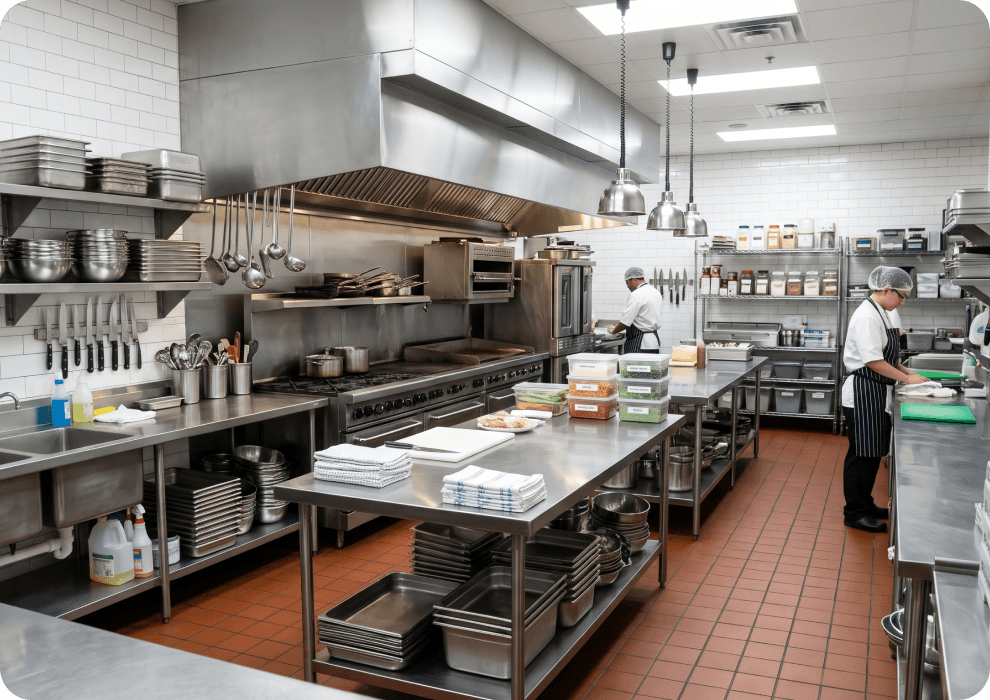
It is Friday, 18:30. The first tables are in, and a cook runs to the walk-in for the third time in ten minutes. First shallots, then cream, then lemons. At closing, half a tray of chopped herbs goes in the bin. Nobody planned it badly. Nobody planned it at all.
This is how most kitchens lose money. It rarely happens in one big mistake. It happens in small trips, double orders and food that nobody uses in time. So kitchen organisation is not about looking tidy. It is about time and food cost.
Below you will find 12 practical tips in four areas: prep, stock, layout and waste. Each tip ends with one action you can try this week.
~14 kg
food wasted per person per year by restaurants and food services in the EU
Eurostat
$7
saved for every $1 invested in cutting kitchen food waste, across 114 restaurants
Champions 12.3
26%
less food waste on average within one year, in the same study
Champions 12.3
Prep and mise en place
1. Use a daily prep list with par levels
A prep list tells each cook what to make before service and how much. It works best with par levels. A par level is simply the amount of an item you want ready before the next service or delivery. You do not prep a fixed amount every day. You prep up to par. This stops both running out and over-producing.
Do this: Write a par level next to every item on tomorrow’s prep list.
Illustrative example: Your par for tomato sauce is 6 litres for a Friday. On Friday morning, 2 litres are left from Thursday. The cook makes 4 litres, not a fresh 6. That saves 2 litres of sauce that might have ended up in the bin on Sunday.
2. Set up mise en place before every service
Mise en place means “everything in its place”. Johnson & Wales University describes it as organising tools, equipment and ingredients before you start cooking. The goal is more speed and fewer mistakes. In practice, every cook checks their station against a short list before the doors open. A missing item found at 17:00 costs one trip. At 19:30, it costs a table’s patience.
Do this: Give each station a printed mise en place checklist and check it 30 minutes before service.
Illustrative example: A trip to the walk-in takes about 2 minutes. Two cooks each make 8 extra trips per shift. That is 2 × 8 × 2 = 32 minutes per shift. Over six shifts a week, it adds up to 192 minutes, or 3 hours and 12 minutes.
3. Label and date everything you prep
An unlabelled tub is a guess. When nobody knows how old it is, someone throws it away to be safe. HACCP is a food safety system: you find the points where things can go wrong and control them. EU Regulation 852/2004 requires food businesses to keep a procedure based on its principles. A UK university HACCP card asks for a description and production date on food prepared more than 24 hours ahead.
Do this: Keep a roll of labels and a marker at every prep station, and label before the tub goes in the fridge.
Illustrative example: A cook finds a tub of basil pesto with no date. It cost €9 to make. Without a label, it goes in the bin. A two-second label would have saved it.
Stock and ordering
4. Store by FIFO and keep fridges at 0–5°C
FIFO means “first in, first out”: older stock is used before newer stock. The Durham University HACCP card puts it as “first expired, first out”. The food that expires soonest goes at the front. Temperature matters too. UK guidance says chilled food must stay below 8°C by law, and the Food Standards Agency (FSA) recommends 0–5°C. It also warns not to overload fridges, because cold air needs space to move.
Do this: When a delivery arrives, put new stock behind old stock, every time.
Illustrative example: A new box of cream goes in front of an older one. The older box expires at the back. Two litres at €7 per litre is €14 in the bin.
5. Count stock weekly and order to par on fixed days
Ordering “by feel” leads to double orders. One person orders on Monday and another on Tuesday, and nobody checks. A weekly count shows what you really have. Fixed ordering days make the routine easy to keep. You order only what is needed to bring each item back to par.
Do this: Choose one person and one day for the weekly count, and set two fixed ordering days with your suppliers.
Illustrative example: Your first count finds three unopened cases of tinned tomatoes at €18 each. They were ordered twice by two different people. That is 3 × €18 = €54 sitting on a shelf. After a month of order-to-par, the extra cases stop arriving.
6. Use one ingredient in several dishes
Every extra ingredient is one more thing to order, store and possibly waste. When one ingredient appears in several dishes, it moves faster. It is less likely to spoil. In our view, it is one of the quickest ways to make a menu easier to run.
Do this: Mark every ingredient that appears in only one dish, and ask if another dish could use it.
Illustrative example: You use roasted red peppers in a salad. Now they also go into a pasta sauce and a lunch sandwich. You buy one 5 kg box a week instead of a small box that often goes soft.
Restaurant kitchen organisation: layout and workflow
7. Build stations with everything within reach
The station idea is old. Auguste Escoffier built the kitchen brigade system with clear stations, and it has shaped kitchens since the late 1800s. Johnson & Wales University suggests putting the most-used items within easy reach. It also suggests splitting stations into prep and service zones. Every step a cook does not take is time back during service.
Do this: Stand at each station during a quiet hour and move the five most-used items to within arm’s reach.
Illustrative example: The grill cook walks to a shelf for salt and tongs. Each trip takes about 10 seconds, and it happens 60 times a service. That is 60 × 10 = 600 seconds, or 10 minutes a service.
8. Clean as you go, with a cleaning schedule
A messy station slows a cook down and leaves a long clean-up at closing. The FSA’s “Safer food, better business” pack for caterers includes “clear and clean as you go”. It also includes a cleaning schedule. The schedule notes what to clean and how often: after use, every shift, daily or weekly. The pack also suggests a review every four weeks.
Do this: Print a cleaning schedule for each area and put one name next to every task.
Illustrative example: Closing clean takes two people 60 minutes. With clean-as-you-go during service, it takes 40 minutes. That saves 20 minutes × 2 people = 40 minutes a night. Over six nights, that is 4 hours of staff time a week.
9. Hold a 5-minute briefing before service
Many problems in service are simple information gaps. A server does not know the fish is nearly gone. A cook does not know about a table of twelve at 20:00. A short briefing fixes this. Keep it standing, keep it short, and cover the same three points every day: specials, items running low, and large bookings.
Do this: Set a 5-minute briefing at the same time every day, with the head chef and the front-of-house lead.
Typical scenario: The chef says there are six portions of sea bass left. Servers stop offering it after the sixth order. Nobody has to go back to a table to apologise. The kitchen avoids remaking a dish with food cost of about €8.
Waste and energy
10. Measure your waste for one week
To reduce food waste in restaurants, measure it first: you cannot cut what you do not measure. Champions 12.3 studied 114 restaurants in 12 countries. They saved about $7 for every $1 spent on cutting kitchen food waste. They also cut waste by 26% on average within one year. In the UK, WRAP’s 2011 data split food service waste into 45% preparation, 34% customer plates and 21% spoilage. About 75% of it could have been eaten. We’d start with a simple one-week audit:
- Set three bins, one each for prep waste, spoilage and plate waste, as WRAP sorts them.
- Weigh each bin at the end of every day.
- Note the main items and the cause, such as over-prep or out of date.
- Act on the biggest bin first.
- Repeat the audit after a month and compare.
Do this: Buy a simple kitchen scale and start the audit next Monday.
Illustrative example: Your week shows 42 kg of waste, and 20 kg is prep waste. That is almost half, so you act there first.
11. Turn trims into stocks, sauces and staff meals
Prep waste is often good food in the wrong shape. Vegetable ends, herb stems and bones can become stock. Bread can become croutons. Staff meals are another good use, as long as the food is still safe. We suggest a “trim box” in the fridge that the morning cook checks each day.
Do this: Put a labelled trim box in the fridge, and plan tomorrow’s staff meal around what is in it.
Illustrative example: The kitchen used to buy stock base at about €6 a day. Now it makes stock from 2 kg of chicken bones and vegetable trims each day. Over six days, that saves 6 × €6 = €36 a week. Over a year, that is close to €1,900.
12. Switch equipment on only when needed and check fridge seals
Kitchens use a lot of energy. ENERGY STAR, a US programme, says restaurants use about 5–7 times more energy per square foot than other commercial buildings. Refrigeration is usually the largest electricity use. ENERGY STAR suggests a start-up and shut-down plan for equipment. It also suggests replacing worn door seals on fridges, freezers and walk-ins.
Do this: Write a start-up time next to each piece of equipment, and check every fridge door seal this week.
Illustrative example: A gas fryer goes on at 10:00, but the first order comes at 12:00. It also sits idle for two hours in the afternoon. That is four idle hours a day. ENERGY STAR estimates that cutting four idle hours a day on a gas fryer saves about $200 a year, at US prices.
Where a digital menu helps the kitchen
Many kitchen problems start when the menu says one thing and the walk-in says another.
When an ingredient runs out mid-service, you can hide the dish in a digital menu such as Platoo in a few clicks. Servers and guests then do not order what is gone.
To see what guests get on their phone after the scan, open an example menu — no sign-up needed.
A smaller, focused menu also helps. Fewer dishes that share ingredients mean fewer items to order and less to waste. A digital menu is easy to update when you remove a dish or change a special.
Prices change too. When supplier prices rise, you can update menu prices in a few clicks. There is no reprint and no waiting for new paper menus.
Make your menu match your stock
Create a free Platoo account, add your dishes and, during your next busy service, hide the first dish that sells out in a few clicks.
Start for freeRelated reading
FAQ
Start with three habits: a daily prep list with par levels, mise en place checked before every service, and stations with the most-used items within reach. Then add a weekly stock count and a short briefing before service. These steps cost very little. They save time every shift and reduce food you throw away.
They measure it first. Sort waste into prep, spoilage and plate waste, weigh it for a week, and act on the biggest bin. In a Champions 12.3 study of 114 restaurants, sites cut food waste by 26% on average within one year. Using trims, FIFO storage and par levels also helps.
A par level is the amount of an item you want ready before the next service or delivery. You prep or order only what brings you back to that amount. For example, if your par for a sauce is 6 litres and 2 litres are left, you make 4 litres.
In the UK, the Food Standards Agency recommends keeping chilled food at 0–5°C. The UK legal limit is below 8°C. Do not overload fridges, because cold air needs space to move. Rules can differ between countries, so check your national food safety authority and your own HACCP plan.
Sources: Eurostat data via ZHAW — 130 kg of food wasted per person annually in the EU · Champions 12.3 — New report finds restaurants save significant money fighting food waste · WRAP — Overview of waste in the UK hospitality and food service sector · Johnson & Wales University — What is mise en place? The key to culinary organization · Durham University — HACCP how-to card: Effective stock control and rotation · legislation.gov.uk — Regulation (EC) No 852/2004, Article 5 · nibusinessinfo.co.uk — Cooking and chilling food · Food Standards Agency — Safer food, better business for caterers · Food Standards Agency — Safer food, better business: cleaning schedule · ENERGY STAR — Restaurants · ENERGY STAR — Guide for cafés, restaurants and institutional kitchens