
Black Friday for Restaurants: 7 Simple Promotions That Work (and the EU Rules to Know)
Black Friday restaurant ideas that work: seven simple promotions for restaurants, cafés and bars, from a hero dish and a set menu to bonus gift vouchers and quiet-hour offers, plus how to check the discount maths and the EU price rules to know.
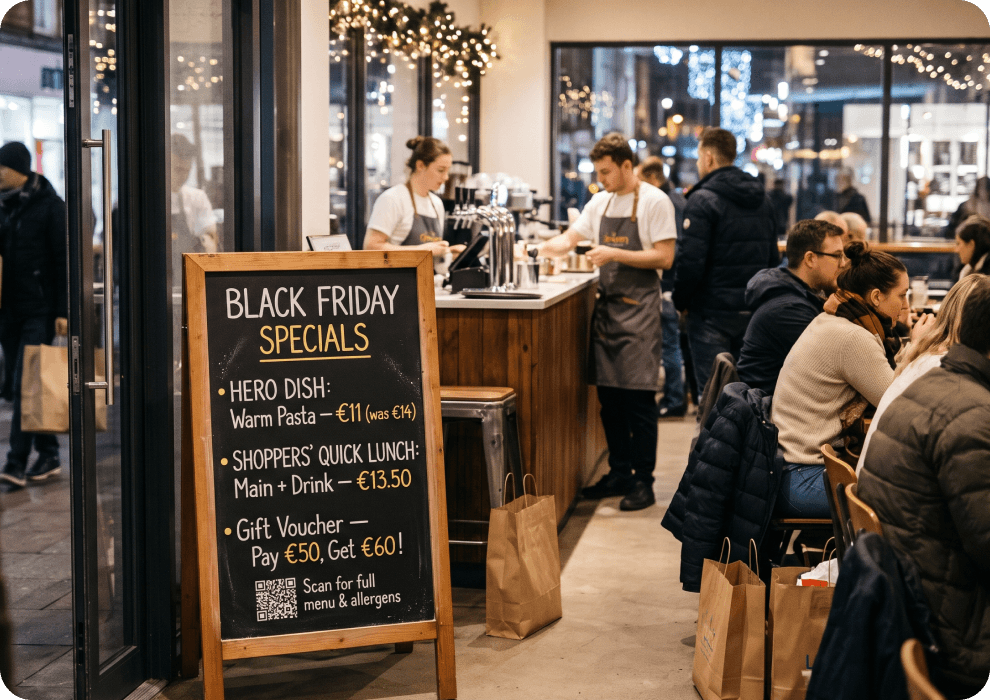
It is Friday 27 November, early afternoon. Your café sits on a busy shopping street. People walk past with bags from the shoe shop and the electronics store. Every window around you says “−50%”. You start to wonder if you should put “−50% on everything” on your own door.
Please don’t. Big retail-style discounts rarely suit restaurants. A shop can discount old stock. You pay for fresh food, staff and energy on every plate you serve.
This article gives you seven simple Black Friday promotions that fit a restaurant, café or bar. It shows you how to check the maths before you discount. It ends with the EU rules on price claims that you should know.
7 Black Friday restaurant ideas that work
The best Black Friday restaurant promotions are small and focused. They target one dish, one time slot or one future visit. Here are seven ideas you can set up in a week. We’d pick two or three of them, not all seven.
1. The hero dish
Pick one popular dish with a low food cost and give it a Black Friday price. Guests get a clear reason to come in. You keep full prices on drinks, starters and desserts.
Illustrative example: Your €14 pasta costs you €3.50 in ingredients. At €11 for the weekend, it still leaves you €7.50 per plate. Most guests will add a drink or a dessert at the normal price.
Tip: Choose a dish your kitchen can make fast, because it will be the most ordered of your Black Friday restaurant specials.
2. The Black Friday set menu
Offer two or three courses at one fixed price. Build it only from dishes with a good margin. In practice, a fixed dish mix often helps you know your food cost per guest in advance.
Illustrative example: A starter (€8), a main (€16) and a dessert (€7) cost €31 on the normal menu. As a set menu, they cost €27. The guest saves €4. If your food cost for the three dishes is €8, you keep €19 per guest.
Tip: Limit the set menu to two choices per course, so the kitchen can prepare more in advance.
3. The shoppers’ quick lunch
Black Friday is mainly a retail event. So the extra people are likely to be on shopping streets and in malls, not in quiet neighbourhoods. If you are near shops, offer a fast lunch: one main and one drink, served in 30–40 minutes.
Illustrative example: A main (€13) and a soft drink (€3) normally cost €16. The shoppers’ lunch costs €13.50. The guest saves €2.50 and is back in the shops within the hour.
Tip: Put the offer on a board outside, with the promise of a short wait.
4. Gift vouchers with a bonus
Sell Black Friday restaurant vouchers with extra value: the guest pays €50 and gets €60 to spend. You get the cash now. The guest comes back later, often in a quiet January.
Illustrative example: You give €10 of extra value on a €60 voucher. Your real discount is €10 ÷ €60 ≈ 16.7%. That is smaller than it looks, and you have the €50 before you serve a single plate.
Tip: Check validity rules first: in Ireland, the CCPC says vouchers must last at least five years, and in Germany a general three-year limit applies.
5. The quiet-hour offer
Most restaurants have slow hours, even on Black Friday. Put your offer there. You fill empty tables instead of discounting tables you would fill anyway.
Illustrative example: A coffee (€3.20) and a slice of cake (€4.80) normally cost €8. Between 15:00 and 17:00, the pair costs €6.50. Ten extra pairs bring in €65 in hours that usually bring almost nothing.
Tip: Show the time slot clearly, so guests at 13:00 do not expect the offer price.
6. The come-back voucher
Give guests a reason to visit again. Anyone who spends a set amount on Black Friday weekend gets a voucher for a weekday visit in early December. The offer pays for itself only if they return.
Illustrative example: Guests who spend €40 or more get an €8 voucher. It is valid Monday to Thursday, 1–10 December. A couple who come back and spend €45 pay €37. That is €37 of revenue from a visit that might not have happened.
Tip: Print the end date and the weekdays on the voucher itself.
7. Book your Christmas party on Black Friday
Groups plan their December parties around this time. Offer a small perk to groups that book that weekend, such as a welcome drink or a free dessert per guest. You secure December revenue early.
Illustrative example: A group of 12 books a €35 party menu, so the booking is worth €420. A free dessert costs you about €1.50 in ingredients per guest. That is €18 in total, or about 4.3% of the booking.
Tip: Ask for the guest numbers and a date at the time of booking, so the perk is linked to a real reservation.
Check the maths before you discount
A discount is not free marketing. It comes out of your margin. To see how much, you need one term. Contribution margin is simply the euros a bill leaves you after food cost. Rent and salaries are paid from this money.
Illustrative example: A guest’s bill is €50. Your food cost is 30%, so €15. That leaves a contribution of €35. Now you give 20% off. The bill drops to €40, but the food still costs €15. Your contribution falls to €25. Divide €35 by €25 and you get 1.4. You need 40% more guests to earn the same money. If you usually serve 100 guests, you now need 140.
That’s a lot of extra plates.
Research on restaurant deals points the same way, although it comes from the US. A 2010 study by Utpal Dholakia at Rice University looked at Groupon promotions. In that study, 42% of the restaurants (20 of 48) said their promotion was unprofitable. A 2011 Cornell survey of 931 consumers by Kimes and Dholakia found another problem. About 44% of social-coupon users were already frequent customers. In other words, many deals sold cheaper meals to people who would have come anyway.
There is some good news too. A 2012 Cornell survey of 273 restaurant operators by Wu, Kimes and Dholakia looked at deal results. Operators said about 40% of deal buyers were new customers. About 35% of first-time deal customers came back without another offer.
So deals can bring new guests. They just cost more than most owners expect. In our view, the safest choice is to discount one dish or one slow hour, not the whole menu.
Change your prices in a few clicks
With a paper menu, a weekend promotion means printing, then printing again on Monday. A digital menu removes that step. With a digital QR menu such as Platoo, you can set a Black Friday price on individual dishes. Guests then see the reduced price next to the dish.
To see what guests get on their phone after the scan, open an example menu — no sign-up needed.
You can change prices in a few clicks and put the normal prices back on Monday. Nothing needs to be reprinted. You can also add a separate Black Friday menu for your set menu or your quiet-hour offer. After the weekend, you simply hide it.
If you get tourists, this matters even more. Platoo translates the menu automatically into the languages you enable. Your new prices show in every language version, so a visitor from Spain or Japan sees the same deal as a local guest.
EU rules for Black Friday discounts
Prices are only one part of a promotion. The way you announce them matters as well. Here is what EU law says, in plain words.
The 30-day rule. Article 6a of the Price Indication Directive 98/6/EC was added by Directive (EU) 2019/2161. It applies from 28 May 2022. When a trader announces a price reduction, it must show the prior price. That prior price is the lowest price the trader applied in at least the 30 days before the reduction. In September 2024, the EU Court of Justice ruled on this in case C-330/23 (Aldi Süd). A percentage discount must be calculated from that lowest 30-day price. In the Aldi case, the shop showed a crossed-out price of €1.69. Its lowest price in the previous 30 days was €1.29.
Does it apply to restaurants? The rule is written for goods. Restaurant meals served at the table are usually treated as services. So Article 6a may not apply to them directly. However, this is not certain everywhere. National law can extend the rules, so check with your local consumer authority.
Rules that cover everyone. The Unfair Commercial Practices Directive 2005/29/EC covers goods and services. It treats false information about a price or a price advantage as misleading, for example a fake “was” price. Its Annex I always bans false claims that an offer is available only for a very limited time. A “today only” deal must really end today.
Vouchers. There seems to be no single EU-wide rule on voucher expiry. Terms and validity periods differ by country.
Authorities do check Black Friday offers.
43%
at least this share of 176 websites checked in a sweep of Black Friday 2022 offers broke the rules
ICPEN
30%
of 314 online traders in 25 countries showed discounts incorrectly, in a Black Friday and Cyber Monday sweep published March 2026
CCPC Ireland
18%
of traders in the same sweep used pressure selling, such as countdown timers or false scarcity
CCPC Ireland
Those checks were of online shops, not restaurants. Still, the same honesty rules apply to your menu and your posters. We’d start with this short checklist:
- Keep your normal price on the menu for several weeks before the offer.
- State the end date of the offer and stick to it.
- Never show an inflated “was” price.
- Write voucher terms clearly, including the expiry date.
This is general information, not legal advice. For your own case, ask a lawyer or your national consumer authority.
Test your Black Friday offer before the day
Create a free Platoo account, set the Black Friday price on your hero dish and check it on your phone, the way a guest will see it, before 27 November.
Start for freeRelated reading
FAQ
It depends on where you are and how you discount. Black Friday is mainly a retail event, so venues near shops are likely to gain the most. A small, focused offer usually works better than a big discount. A 20% cut on a €50 bill with 30% food cost needs 40% more guests to earn the same.
Good ideas are narrow and easy to run. Try one hero dish at a lower price, a fixed-price set menu or a quick lunch for shoppers. Bonus gift vouchers bring cash now. Quiet-hour offers fill slow tables. Come-back vouchers and Christmas party perks bring guests back in December.
Article 6a of Directive 98/6/EC is written for goods. Restaurant meals are usually treated as services, so the rule may not apply directly. National law can differ, so check locally. Fake “was” prices and false “today only” claims are banned for services too, under the Unfair Commercial Practices Directive.
Black Friday 2026 is on Friday 27 November 2026. It is the day after US Thanksgiving, which falls on the fourth Thursday of November. Cyber Monday follows on Monday 30 November 2026. Plan your offer, your menu changes and your staff rota a few weeks before that weekend.
Sources: European Commission — Price Indication Directive · Lawplayer — Directive (EU) 2019/2161, Article 2 (amending Directive 98/6/EC, Article 6a) · Court of Justice of the European Union — Press release 152/24, Case C-330/23 Aldi Süd · Noerr — Impact of the CJEU ruling on discount advertising in Europe · Your Europe — Unfair pricing · legislation.gov.uk — Directive 2005/29/EC (Unfair Commercial Practices Directive) · legislation.gov.uk — Directive 2005/29/EC, Annex I · ICPEN — Black Friday sweep of online offers · CCPC Ireland — 1 in 3 traders incorrectly display discounts online during Black Friday sales · CCPC Ireland — Gift vouchers · Oeko-Test — Gutscheine als Weihnachtsgeschenk · Rice University (Dholakia, 2010) — How effective are Groupon promotions for businesses? · Cornell University (Wu, Kimes & Dholakia, 2012) — Restaurant operator experiences with daily deals · Cornell Chronicle (Kimes & Dholakia, 2011) — Social coupon users survey